2019/05/31 (Friday)
| Setup | DIB1/3/4 → 3.2 MHz filters 2/3/1 → cable 3/1/2 → gender changer ?/3/2 → HVConn 1/3/2 → HV 1/2 → DCRCX(4)/DCRC50(3) DCRC33(2) → 1kV power supply → HV input |
|---|---|
| 0000 | Tower = 55.2 mK |
| 0905 | Tower/MC/Coldplate = 54.2/31.5/199 mK, Still = 1.27±0.02 K / 0.095 mbar, G1/G2 = 175/171 mbar, 1K Pot = 1.63 K / 22 mbar. MB = 35.8% |
| Tower temperature continues to fall linearly, slowly | |
| 0915 | Fill LN2 cold trap bath |
| 0940 | Check the phonon channels - all still look OK. |
| Let's take some more data. We don't seem to have enough stats to see any Am lines below 60 keV. (They'll be harder to see at 0 V but should be visible.) | |
| 0942 | Start a sequence of 9 20-minute background series at HV = 0V CDMS detector: Driver Gains = 1x, DCRC4/3 QET biases = (420/370/440)/(420/400/450) uA, Front-End Gains = (2/2/3)/(5/5/5) 1000 BOR randoms, trigger on DCRC4pA/B/C threshold = 4/5/5 use SimpleDataLoopNoFlash.msl |
| Let's try applying bias. Start with a manual bias. Turn on power supply, dial to 0, then plug in power to HV input on HV box. All channels still look OK. | |
| 1250 | Start a series at HV = 0V, then dial up to 125V. After 30 min dial back down to 0V. CDMS detector: Driver Gains = 1x, DCRC4/3 QET biases = (420/370/440)/(420/400/450) uA, Front-End Gains = (2/2/3)/(5/5/5) 1000 BOR randoms, 10 Hz in-run randoms, trigger on DCRC4pA/B/C threshold = 7/7/7 |
| 1255 | Wasn't looking at the voltage on the test resistor initially. Looking now after applying 125V, it looks flat at 0.10 mV. This is unusually low… Check pulses, look strong. Higher amplitude than before so I think we have Luke gain. |
| In the last run the counter bias canceled an applied 200V after 1000 seconds. So this may last about 10 minutes. Let's try dialing bias to 0V after 15 or 20 minutes. | |
| 1300 | Tower = 53.8 mK |
| 1319 | Dial HV down to 0V |
| 1335 | Vtest has been falling slowly, was at 0.10 mV, now 0.07 mV. If this is correct then we may have much lower leakage with this wiring than in the last run when the bias was routed through the SQUET. |
| 1353 | Stop data. |
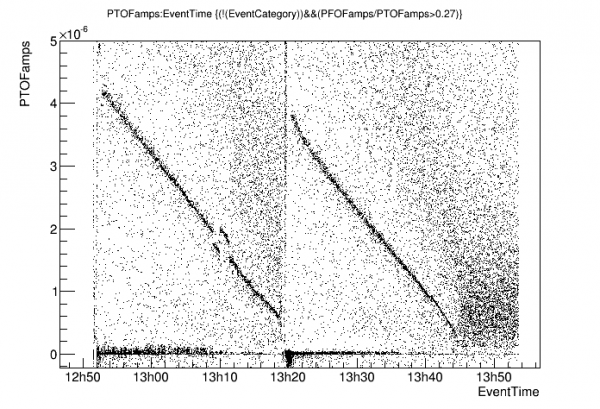 | 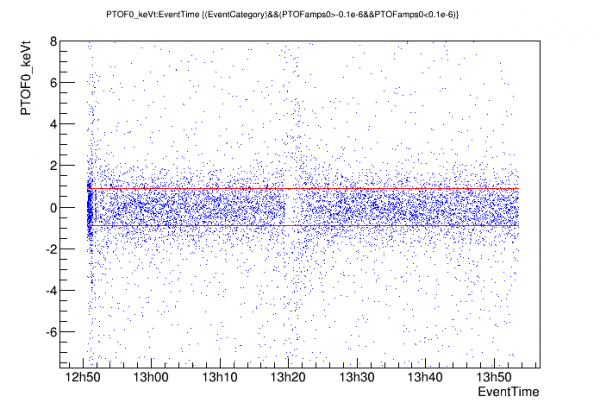 |
- Comparing to 0-Volt data, the maximum Luke gain is 32.1, or extrapolated to t0, 34.2
- these correspond to 93.4/99.7 V at the detector
- roughly corresponds to the 1.27 reduction of electrode voltage to detector voltage assuming 0.55 mm gap, Ge dielectric constant 16.2
- between 3 and 8 minutes, noise width is 35 eVee.
- noise width seems pretty constant at 910 eVt (total phonon energy)
- somewhat higher than the 710 eVt seen in 0-Volt data
| 1439 | Start LHe transfer @ MB = 27.6% |
|---|---|
| 1520 | End LHe transfer @ MB = 95.6% |
| 1620 | MB = 95.1% |
| 1700 | Fill LN2 cold trap bath |
| 1720 | MB = 94.5% |
| 1820 | MB = 93.7% |
| 1920 | MB = 92.7% |
| 2020 | MB = 91.7% |
| 2120 | MB = 90.5% |
| 2220 | MB = 89.4% |
| 2320 | MB = 88.2% |
| 0020 | MB = 87.0% |