2019/04/05 (Friday)
| Setup | DIB1/3/4 → 3.2 MHz filters 2/3/1 → cable 3/1/2 → gender changer 3/?/2 → HVConn 1/3/2 → HV 1/2 → DCRCX(4)/DCRC50(3) DCRC33(2) → 1kV power supply → HV input Lead poly shield is erected, N/E/W walls complete, no poly or lead on S wall. |
|---|---|
| Overnight | Base temp has been a little unstable since 0500, with an average low of 39.3 mK, but short excursions as high as 40.8 mK. Ran a sequence until 2AM, still no MIDAS crashes since cdms2 rebuild. |
| 0930 | Tower/MC/Coldplate = 39.5/29.7/187 mK, Still = 1.71±0.15 K / 0.150 mbar, G1/G2 = 292/269 mbar, 1K Pot = 1.77 K / 13 mbar. MB = 35.5% |
| 0938 | Fill LN2 cold trap full. |
| 1030 | Swap HV polarity. |
| 1030 | Start 4x background series at HV = -300→-400V @ 2.42 V/min (40 min duration) with 1 minute 15% prebias CDMS detector: Driver Gains = 1x, DCRC4/3 QET biases = (440/380/430)/(500/460/410) uA, Front-End Gains = (2/2/3)/(5/2/5) 1000 BOR randoms, trigger on use sequence HVdrift_4x300V_2p42VPM_prebias_15_1_dur_40min.msl |
| 1115 | Later: Noticed that Vleak suddenly went from -11 mV to -0.68 V! |
| 1150 | Tower base has slowly risen to 41.5 mK. Might have a channel in a bad state. |
| 1155 | Stop series after flash. |
| 1200 | DCRC4 pA is okay, DCRC4 pB is ringing bad, DCRC4 pC is okay after a snap. DCRC3 pC is showing weird, inverted pulses. Looking at last series, things were good until sometime in minute 36 when DCRC4 pB started ringing and DCRC3 pC started looking like this. |
| 1205 | Turn QET biases down to 0, then snap, then return to normal settings. DCRC4 pB still ringing and DCRC3 pC still inverted. Tower temp is slowly coning down though, at 40.6 mK now. |
| 1215 | Try to find a good setting for DCRC4 pB, it seems to ring all the way down to SC. But if we go higher, to 410, we get inverted pulses on this channel too! What's going on? |
| 1217 | Set QET biases to 0 and zap SQUIDs. |
| 1305 | Tower = 39.3 mK |
| 1310 | Snap all channels. Start putting them back into transition. All channels back in transition and no oscillations. Let's try to take biased data again. |
| 1317 | Start 4x background series at HV = -300→-400V @ 2.42 V/min (40 min duration) with 1 minute 15% prebias CDMS detector: Driver Gains = 1x, DCRC4/3 QET biases = (440/380/430)/(500/460/410) uA, Front-End Gains = (2/2/3)/(5/2/5) 1000 BOR randoms, trigger on DCRC4pA/B/C threshold = 6/6/6 use sequence HVdrift_4x300V_2p42VPM_prebias_15_1_dur_40min.msl |
| 1330 | Gah, DCRC3 pD is SC. Try to snap and restore it as the data is taking. Can't seem to get it back easily. This data is garbage. Stop logging Doesn't help that DCRC_UI is really laggy. |
| 1340 | Still struggling to rein in DCRC3 pD. There is very little room below the oscillations and SC. Can run above the oscillations at ~500uA. |
| 1345 | HV drift is still going on. Starting to see wierd pulse shapes in DCRC3 pC,pD as before. No ringing in any channels though. |
| 1405 | Stop sequence at -400 V and turn down HV using HVchange_400_to_0.msl |
I'm worried that we're slowly killing one of our SQUETs or striplines with HV. Here is the current mapping and status based on SQUID tests and channel behavior. The one stripline/SQUET (and sidecoax/DIB) that is getting HV is the one which is having issues.
| HV side 2, Readout Side 1 Map | |||||
|---|---|---|---|---|---|
| DIB channel | Detector channel | SQUET | Stripline | DCRC channel | Status |
| DIB1 PA | S1 PE | ZC-68 | 43 | DCRC4 PA | Okay |
| DIB1 PB | S1 PB | ZC-68 | 43 | DCRC4 PB | Okay |
| DIB1 PC | S1 PD | ZC-68 | 43 | DCRC4 PC | Okay |
| DIB3 PC | S1 PA | ZC-23 | 41 | DCRC3 PB | SQUID okay, TES bad |
| DIB4 PA | - | ZC-24 | 48 | HV | - |
| DIB4 PC | S1 PC | ZC-24 | 48 | DCRC3 PC | SQUID bad, TES ? |
| DIB4 PD | S1 PF | ZC-24 | 48 | DCRC3 PD | SQUID okay, TES ? |
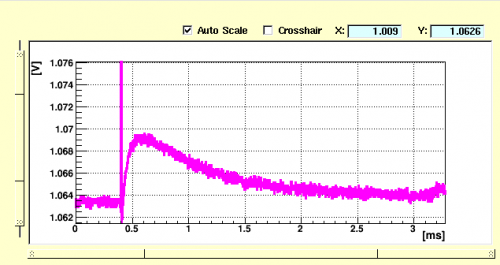
| 1426 | Flash detector |
|---|
Aside: During the flash we see pulses like this with very uniform amplitude. Maybe some crosstalk at the start then phonon pulse? There has been talk about using such things for calibration.
| Phonon signal during flash |
|---|
 |
| 1440 | Commence LHe transfer, MB=27.7% |
|---|---|
| 1452 | Let's do a quick electrical check of DIB4 during the transfer. Turn off DCRC programs and power down DCRCs 3,4. |
| 1510 | Observations: DIB4 pA SQUID/ret and FB/ret are open. We HV bias these along with DIB4 pA QET lines. Hopefully we didn't damage them. No shorts from DIB4 pA lines to DIB4 pC, pD lines. Might expect to see a short there if the HV is leaking to the grounded channels, but no smoking gun here. Measuring a single LED with meter in diode mode for 2 seconds heats fridge to 170 mK. Maybe we need to set the LED currents higher in the DCRCs for some reason? Also checked HV1 port connections to HV bias on HV board, but no obvious shorts. |
| 1530 | Cease LHe transfer, MB=88.0% |
| 1558 | Put everything back together, power up DCRCs. |
| 1600 | Zap SQUIDs. |
| 1614 | After Zap tower temp started to fall to 42.5 mK, then rose to 43.9 mK. Set all QET biases = 0, toggle 15V power ON/OFF. |
| 1620 | Tower temp = 43.6 mK and slowly decreasing |
| 1638 | Tower = 10.4 mK and slowly cooling. Get all channels into transition and looking good. |
| 1645 | Flash detector. |
| 1646 | Fill LN2 cold trap full. |
| 1650 | Set HV polarity to positive. |
| 1651 | Tower = 40.0 mK and cooling. |
| 1657 | Start 6x background series at HV = 300→400V @ 2.42 V/min (41 min duration) with 1 minute 15% prebias CDMS detector: Driver Gains = 1x, DCRC4/3 QET biases = (440/380/430)/(500/460/410) uA, Front-End Gains = (2/2/3)/(5/2/5) 1000 BOR randoms, trigger on DCRC4pA/B/C threshold = 6/6/6 use sequence HVdrift_6x300V_2p42VPM_prebias_15_1_dur_41min.msl |
| 1707 | Accidentally start a run for a few seconds and write data. |
| 1710 | Real series starts. Pulses look fine so far. Hopefully they stay that way. |
| 1712 | HV=306.6V, but Vleak = 0.526 Grrrr! Hadn't been watching this today, and now I see that it was going this high since 1115 today. This is like a 200V drop! |
| 1719 | Stop the sequence and the run. Turn down HV manually. |
| 1724 | Start 6x background series at HV = 0V, 60 min duration CDMS detector: Driver Gains = 1x, DCRC4/3 QET biases = (440/380/430)/(500/460/410) uA, Front-End Gains = (2/2/3)/(5/2/5) 1000 BOR randoms, trigger on DCRC4pA/B/C threshold = 6/6/6 use sequence SimpleDataLoopNoFlash.msl |
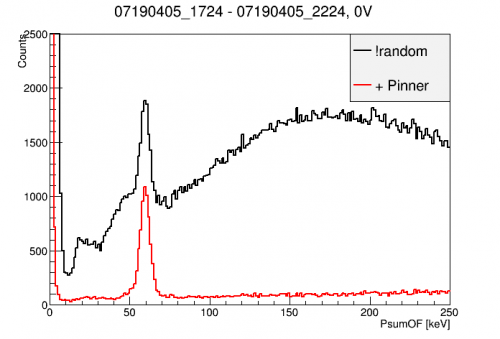 |
| Calibrated spectrum with and without crude Pinner cut |
|---|
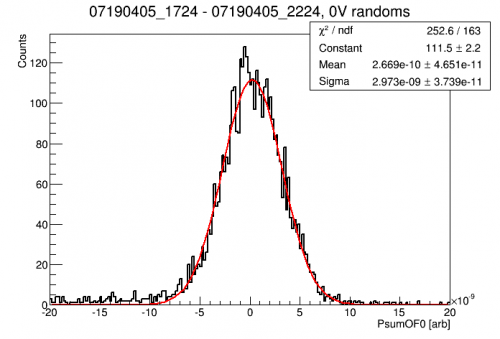 | 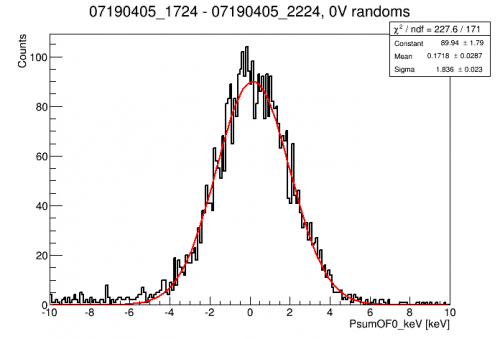 |
| Uncalibrated randoms | Calibrated randoms |
|---|