Previous Day
| 0935 | MIDAS still running with logging off. Stop MIDAS run. Turn logging on. |
| 0937 | Start test data series with 1000 initial randoms at 20Hz and DCRC3 phonon triggers =(15/15/15/15). DCRC1,3 phonons connected to 5kHz test signals at the preamp(DCRC1) and the feedback amp(DCRC3). |
| 0947 | Stop data series. |
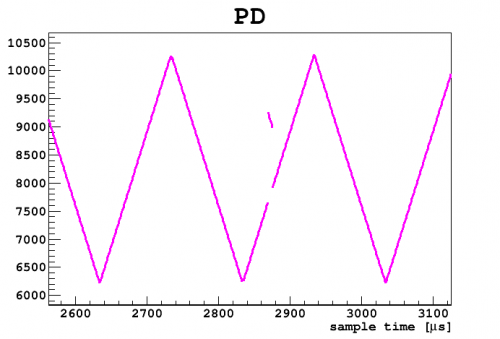
| 0950 | Again, casually scanning through saved data using BatViewer, spotted a mid-trace glitch on DCRC3 PD in series 07190205_0937 around event 21888. There are 8 bins of data that seem to not belong here, though they have the correct slope, so are certainly from real data. |
| 0953 | Stop DCRC programs and power down DCRCs. |
| 1320 | Quick analysis of test signal data sets. |
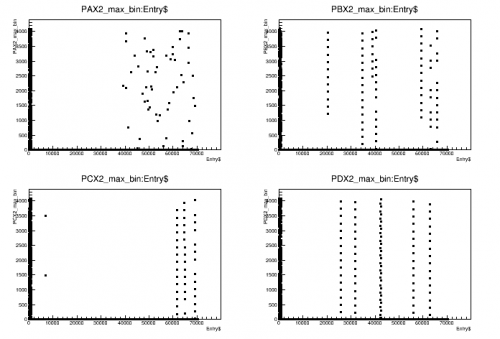
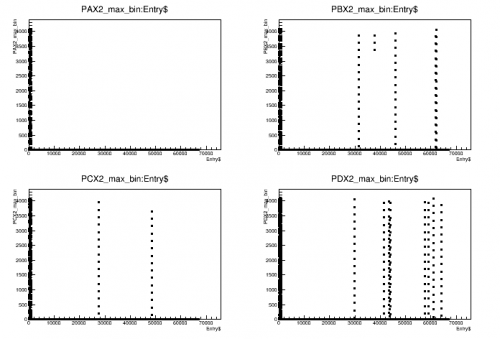
The test signal data taken yesterday and today were triggering on DCRC3 phonon channels in such a way that the signal remained correlated with the trigger time. This allowed glitches to be identified using the chisq between each event trace and the average event trace. It also allowed the glitchy bins to be located by their locally high chisq. The figure below plots the worst fitting bin number as a function of Entry for DCRC1's phonon channels in the 2 datasets. The dark band at the left of each plot is due to initial random triggers which are uncorrelated with trigger time. The band at the bottom is the frequently occurring first-8-bin glitch. In PB,PB,PD, the vertical streaks are glitches of the type shown in the figure above, which appear for several events in a row due to the high trigger rate. These seem to occur more frequently later in each run, but the two series do not seem to have an overall difference in occurrence.
The other points in PA are not understood. The traces themselves have no obvious glitches, and the chisq values are quite low. It may simply be that the signal became slightly (~1 bin) out of phase in this channel at these times.
| 07190204_1658 | 07190205_0937 |
 |  |
An interesting observation is that these particular glitches persist in the waveform across several events. This is shown below for series 07190204_1658, entries 25780-25782. This may be an indication that this glitch is occurring before the main 3s buffer, since it remains across multiple reads. Further, while the glitchy values seem to have a slope consistent with the test signal, their absolute values are far different from those spanned by this channel. In fact, only channels PA and PC cover those values. Does this mean they are from a different channel's buffer? We could re-do this test with the 4 channel ranges well separated to try and deduce the source of the glitch values.
| Entry$ | PD Trace |
| 25780 | 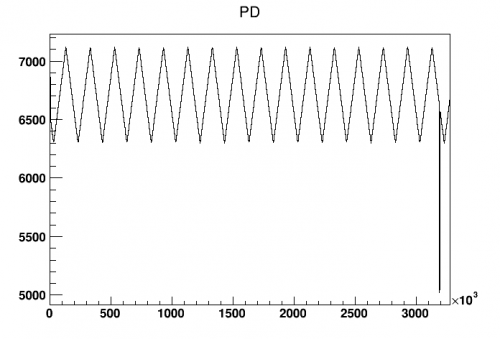 |
| 25781 | 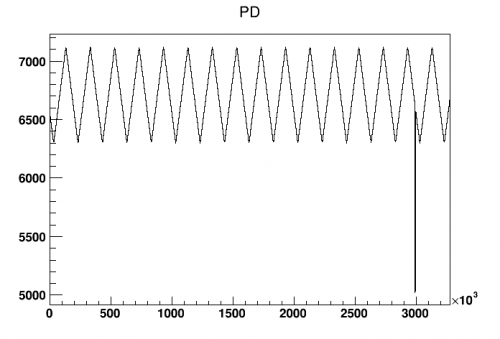 |
| 25782 | 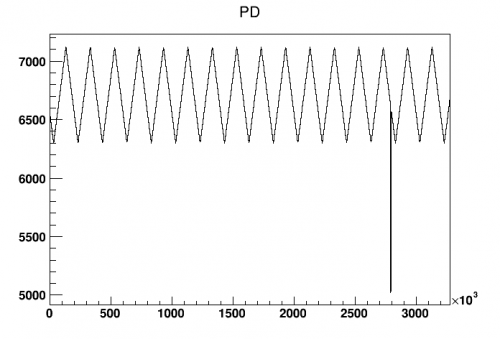 |
Next Day