2018/03/15 (Thursday)
| Status: LN2 transfer yesterday. Several cryocleanings done, mixture exposed to cold LN2 Trap 1 overnight (no mixture in fridge). 1K Pot evacuated and isolated. | |
| 0915 | MC(Cernox) = 76.9 K, Sorb = 118.7 K, IVC = 3.4 mbar increase in IVC overnight is worrying |
| 0920 | Pump mixture out of Trap 1 to dump |
| 0920 | Pump out IVC with scroll pump, then turbo pump |
| 0940 | Let about 440 mbar mixture into cold LN2 Trap 2 through v13b, then close v13b |
| 0945 | Closer Condenser valve, open v1. Then open 12b+speedivalve, and close it again. This lets the mixture in Trap 2 into the 4He cold trap. Then open condenser valve. This lets the mixture in the 4He trap into the condenser. G1 = 398 mbar before opening Condenser, 363 mbar after opening Condenser. This in itself is a mini- throughput test. Since the still side is vacuum we should see G1 fall as this mixture moves through the still impedance. |
| 0950 | Open Still valve. This should allow us to see the pressure on the still side rise on P1. |
| 1000 | Throughput doesn't look good. Condenser is falling very slowly, 0.02 mbar/min. This may simply be the mixture cooling. P1 is very low, 0.022 mbar, rising extremely slowly, 0.2 μbar/min. |
| 1005 | Open v3 to let mixture into Still, so condenser side and still side equilibrate. G1 (condenser) falls from 363 mbar to 17 mbar. |
| 1010 | Let more mixture from dump through Trap 2 into fridge. G1 → 256 mbar. |
| 1010 | Mini-throughput check: close off Trap 2 and V3. Only V1, condenser speedivalve, still gate valve, and V9 open. Turn on 3He pump, then open V6 to 12.8%. This pumps mix out of the still side and we can see if the pressure goes down on the condenser side. G1 (condenser) started out at 256 mbar, did not fall. Throughput < 0.04 mbar/min. |
| 1025 | Pump mixture from fridge and Trap 2 to dump |
| Throughput test procedure, Cold Trap 2: |
- All mixture in dump, LN2 traps cold, condenser & still valves open (3He pump on - optional)
- Open V9, V13b, V12b+speedivalve, V3. Wait for G1 to be close to G2.
- Close V12b+speedivalve and V3, open V1
- monitor G1
| 1030 | Perform mixture throughput test at MC = 77 K using above procedure. Let G1 rise to 570 mbar before Step 3, then it falls to 32 mbar, rise is very slow. Throughput 0.08 mbar/min. We have another blockage. |
|---|---|
| 1045 | Pump mixture out of fridge and Trap 2 to dump |
| 1240 | Leak Detector on IVC. Close off turbo pump. LD = 146 pbarL/s |
| 1240 | Put level resistor in main bath: 1.237 kΩ. MC(Cernox) = 76.9 K, Sorb = 119.6 K |
| 1250 | LD = 157 pbarL/s |
| 1250 | Begin blowing out LN2 into cold trap bath Dewar. G3 (main bath) = 498 mbar. After 5 minutes switch to 25L bomb Dewar. |
| 1255 | warm LN2 Trap 1 = 10.0 mbar. This was the one the mixture was exposed to overnight. |
| 1300 | LD = 155 pbarL/s. Main bath = 491 mbar (above 1 atm). |
| 1310 | LD = 150 pbarL/s. Main bath = 484 mbar. |
| 1320 | LD = 148 pbarL/s. Main bath = 477 mbar. |
| 1325 | LD = 172 pbarL/s. Main bath = 474 mbar. |
| 1330 | LD = 266 pbarL/s. Main bath = 479 mbar. |
| 1335 | LD = 346 pbarL/s. Main bath = 245 mbar and falling, blowout almost finished. |
| 1337 | LD rising quickly… Main bath = 178 mbar |
| 1340 | LD = 350,000 pbarL/s. Main bath = 163 mbar. |
| this leak is actually worse than last time. It really seems to happen right when the pressure falls, which seems like it's not happening at the level of the IVC joint. So it's happening when we start blowing helium into the lab, maybe?? | |
| Closing the IVC valves at the top of the fridge causes the leak rate to fall, so it's not a problem with the downstream plumbing | |
| 1345 | LD = 740,000 pbarL/s. Main bath = 151 mbar. |
| 1345 | Stop pressurizing main bath, blowout finished |
| 1350 | LD = 712,000 pbarL/s. Main bath = 104 mbar above 1 atm. |
| 1353 | Begin pumping out IVC with scroll pump. Pump a little slower than usual to watch the leak rate. |
| 1355 | LD = 600,000 pbarL/s. Main bath = 22/30 bar absolute (mechanical gauge). |
| 1400 | LD = 390,000 pbarL/s. Main bath = 10/30 bar. |
| 1405 | LD = 50,000 pbarL/s. Main bath = 10 mbar (P2). |
| 1410 | LD = 6,000 pbarL/s. Main bath = 0.36 mbar. |
| 1415 | LD = 2,400 pbarL/s. Main bath = 0.13 mbar. |
| 1420 | LD = 1,580 pbarL/s. Main bath = 0.08 mbar. |
| 1420 | Try squirting He around top of fridge, stripline tube and plumbing behind ebox. No noticeable increase in leak signal. |
| 1425 | LD = 1,080 pbarL/s. Main bath = 0.05 mbar. Close valve to scroll pump, let main bath sit at vacuum. |
| 1430 | LD = 991 pbarL/s. Main bath = 0.24 mbar. |
| 1430 | Try squirting He around top of fridge again. Leak signal does increase a little, 997 to 1,070 pbarL/s, then back down to 1,030. |
| 1435 | Let one tube-length of He into main bath, pressure increase from 0.29 to 0.9 mbar. LD 1,030 → 2,350 pbarL/s and climbing. Levels out around 2,700 |
| 1440 | Let one more tube-length of He into main bath, pressure increase from 1.0 to 2.2 mbar. LD 2,730 → 3,400 pbarL/s and climbing. Levels out around 4,400 |
| 1445 | Pump on main bath again with scroll pump. LD falling, around 10 pbarL/s per second |
| 1450 | LD = 2,600 pbarL/s. Main bath = 0.19 mbar. |
| 1455 | LD = 1,360 pbarL/s. Main bath = 0.08 mbar. |
| 1455 | Fill main bath with N2. Leak signal falling. |
| 1500 | LD = 590 pbarL/s. Main bath = 19/30 bar (mechanical gauge). |
| 1505 | LD = 470 pbarL/s. Main bath = 122 mbar over 1 atm (G3). |
| 1510 | Try squirting controlled amounts of He down the LN2 fill tube. Very little change in leak signal, maybe 495→500 pbarL/s |
| 1510 | Squirt short blast of He down LN2 fill tube, enough to hear gas come out of the other (uncorked) port. Leak signal 560 → 1500 pbarL/s and climbing… rises above 5,000, starting to plateau. |
| 1515 | LD = 7,000 pbarL/s |
| 1520 | Try a blast of He down the third fridge port, with the recovery port open (ping pong ball cover). In this case the helium will mostly just come in the top and back out the top. Leak signal does not rise. In fact it has been falling the last few minutes. |
| 1523 | Another blast of He down the LN2 fill tube. Leak signal starts at 5460 pbarL/s, several second delay, then quick rise. Reaches 7700 in after a couple of minutes. |
| 1530 | Raise the LN2 tube 1 inch so it is no longer seated in funnel, then squirt a blast of He down it. Leak signal began at around 8000 pbarL/s, does not rise, in fact it is falling. |
| 1535 | Push the LN2 tube back into the funnel, then squirt another blast of He down it. Leak signal began at around 6980 pbarL/s, after a few seconds starts rising rapidly, to 10,000 in a couple minutes. |
| This strongly suggests that the leak is in the lower part of the IVC, somewhere below the funnel for the LN2 fill. |
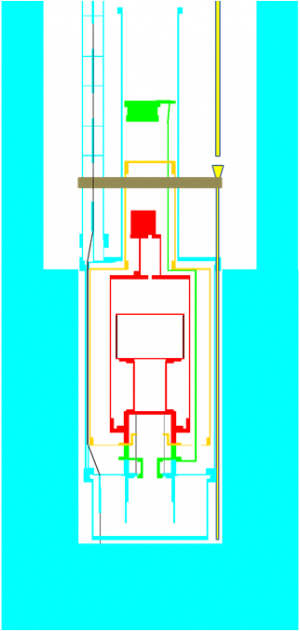
As shown in the diagram above the funnel is above three seals: the bottom IVC seal, the middle IVC seal, and the stripline tube / IVC seal. So any of those could in principle be where the leak is. But during blowout the leak signal began its steep rise only at the very end of the transfer, so I still suspect the bottom seal.
This is twice that it failed. Both times I (Matt) assembled the indium o-ring. It's possible I've gotten sloppy with the vacuum grease and put too much on. If the seal depends on a significant amount of grease it's not surprising that it would fail when cold.
| 1630 | Begin cryocleaning mixture through Trap 2, V6=12.4% |
|---|---|
| 1635 | MC(Cernox) = 77.1 K, Sorb = 132.8 K |
| 1635 | Let 2.2 mbar N2 into IVC. This is two tube-lengths. Pressure dropped after closing valve, close to boiling point so pressure may be lower than otherwise. Should be enough, don't want to overdo it. |
| 1640 | Increase V6 → 12.8% to reestablish flow |
| 1645 | MC(Cernox) = 77.45 K, Sorb = 134.9 K, Cryostat outer surface = 23.3 C |
| 1650 | Close IVC valves then move pump line to cryostat vacuum jacket valve |
| 1655 | Let 100 mbar N2 gas into vacuum manifold. Then open cryostat vacuum jacket valve to let this into the vacuum jacket. |
| 1700 | MC(Cernox) = 77.7 K, Sorb = 136.6 K, Cryostat outer surface = 23.0 C |
| 1700 | Let 100 mbar N2 gas into vacuum manifold. Then open cryostat vacuum jacket valve to let this into the vacuum jacket. |
| 1700 | Increase V6 → 12.9% to reestablish flow |
| 1705 | MC(Cernox) = 77.85 K, Sorb = 137.5 K, Cryostat outer surface = 22.5 C |
| 1715 | MC(Cernox) = 78.1 K, Sorb = 139.6 K, Cryostat outer surface = 21.9 C |
| 1720 | Finish cryocleaning. Pump mixture back to dump. |
| 1730 | Open mixture to cold LN2 Trap 1 by opening v9 and v13a |
| 1735 | MC(Cernox) = 78.8 K, Sorb = 145.3 K, Cryostat outer surface = 21.0 C |
| 1950 | MC(Cernox) = 92.9 K |
| 2110 | MC(Cernox) = 105.44 K |
| warming time constant looks like it's around 21 hours, won't hit 273 K till Saturday evening |
| Cryocleaning log | |||
|---|---|---|---|
| date | trap | duration (minutes) | contaminants removed (mbar) |
| Mar 13 | 2 | 70 | 8.1 |
| Mar 13/14 (overnight, no circulation) | 1 | overnight | 7.5 |
| Mar 14 | 2 | 70 | 8.9 |
| Mar 14 | 1 | 70 | 6.6 |
| Mar 14 | 2 | 70 | 4.8 |
| Mar 14/15 (overnight, no circulation) | 1 | overnight | 10.0 |
| Mar 15 | 2 | 50 | |
| Mar 15/16 (overnight, no circulation) | 1 | overnight | |