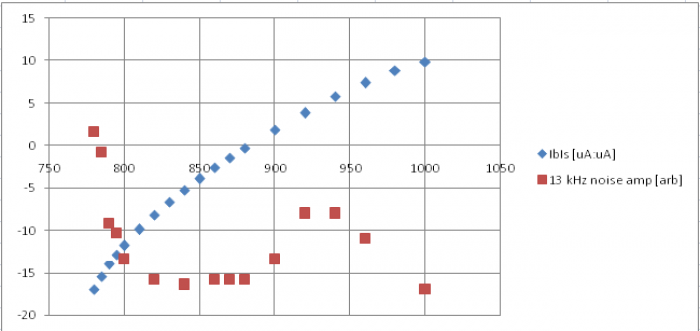
| | Choose 840 uA as standard bias for DCRC3pB / Side2pB |
| 1351 | Start 10 min long trace randoms data series at HV=0V, no HV board, Driver Gains = 2x, QET biases = (500/420/510/0)/(na/840/400/540) uA, Front-End Gains = 10/5 on DCRC1/3, DCRC1,3 trace length = 13.1072ms, Trigger on 20Hz randoms. This is DCRC3pB/Side2pB in transition, and other channels too except DCRC1pD/Side2pE which is s/c. |
| 1403 | Start 19 min long trace randoms data series at HV=0V, no HV board, Driver Gains = 2x, QET biases = (500/420/510/0)/(na/0/400/540) uA, Front-End Gains = 10/5 on DCRC1/3, DCRC1,3 trace length = 13.1072ms, Trigger on 20Hz randoms. This is DCRC3pB/Side2pB and DCRC1pD/Side2pE which in s/c, others in transition |
| 1430 | Turn off MIDAS DAQ programs and unplug DCRCs. Tower: 22.4 → 21.6 mK. Plug DIB3(Cable 1) into DCRC52(6). |
| | Setup: DIB1/3/4 → SL 27/19/20 → 3.2 MHz filters → cables 2,1,3 → DCRC55(1)/DCRC52(6)/50(3). |
| 1440 | Power DCRCs and start DAQ programs. Tower → 22.6 mK. |
| 1445 | Zap SQUIDs on DCRCs 1,3,6 twice. |
| 1450 | Zap SQUIDs on DCRCs 1,3,6 twice. |
| 1500 | Take a look at DCRC3pC, the one that seems to have gone bad since last Friday's floating phonon tests. It still looks awful. |
| | Start warmup |
| 1515 | Close V6 to stop circulation and allow mix to expand into still line |
| 1520 | Tower → 200 mK. Condenser pressure falling, Still pressure rising. |
| 1520 | Pump mix out of Trap 2: Close V13b to close inlet to trap, close V1 to isolate condenser. Open V9 to open pump outlet to dump. Open V5 to pump out Trap 2. |
| 1535 | Isolate Trap 2 and 3He pump: close V12b to isolate Trap 2, close V5 to stop pumping on lines, close V9 to isolate 3He pump from dump. |
| 1540 | Turn off 3He pump. |
| 1540 | Open Condenser to Dump by opening V1 and V4 |
| 1540 | Open Still to Dump by opening V14 |
| 1545 | Condenser (G1) = 20.5 mbar, Still (P1) = 150 mbar (out of range), Tower = 480 mK |
| 1545 | Close 1K Pot speedivalve to stop pumping on pot. Leaving needle valve open. Close V4a and valve to 4He pump. Open 4He outlet to “exhaust” and close recovery valve. Turn off 4He pump. |
| 1550 | Tower = 520 mK. Leaving the tower thermometer on with range reduced to 6.32 kΩ and excitation left at 6.32 uV |
| 1615 | Tower/1K Pot = 0.554/3.14 K, both rising |