2016/11/10 (Thursday)
| Setup: DIB1/3/4 → 3.2 MHz filters → cables1/2/3 → DCRC55(1)/33(2)/50(3) | |
| Last night's data looked OK in the first series at 16:06, but by the second series at 17:06 the noise in DCRC3pD, which we were triggering on, must have increased, so that most of the pulses are noise triggers. Then in the middle of the run at 23:07, DCRC1pD railed. (That's an inner ring channel on Side 2 so probably not the most critical one for analysis.) | |
| 0900 | Fill LN2 cold trap bath. |
| 0930 | Tower/MC/Coldplate = 32.8/35.9/232 mK, Still = 1.37 K / 110 μbar, G1/G2 = 175/165 mbar, 1K Pot = 1.70 K / 28 mbar. MB = 21.6%. Boiloff rate: |
| 0951 | Start LHe transfer @ 20.7% |
| 1045 | Finish LHe transfer @ 91.5% |
| 1140 | Unrail DCRC1pD using “Auto Zero once” on the SQUID Tuning gui. Then set its baseline back down to -0.8 V |
| 1145 | Check event rate, count 33 events in 1 second = 33 Hz. Down from 46 Hz yesterday, 110 Hz the day before. |
| 1200 | DIB2pC seemed to have high 10kHz oscillations so tried adjusting its QET bias downward. Sometime during this process, all other channels railed! After restoring them they had no pulses, probably superconducting. Annoying, I don't know what happened. Possibly an operator error caused a glitch. For example I tried Auto Zero on DCRC2, which I know does not work, apparently because it's RevC not RevC.1. Maybe this does something weird. |
| 1205 | Release pressure from main bath |
| 1210 | On DCRCpA tried “snapping” QET bias to 800, then down to 200 - at 200 saw pulses. Then to its previous value of 179. But this put it into superconducting. So maybe this is one of those situations where suddenly a previous parasitic power source disappeared, so that now all the channels will require a higher bias. |
| 1355 | DIB1pA seemed to require a QET bias 3 μA higher than previous. Try applying 3 μA higher QET biases to all DCRC1 channels - seems to have work, all have good pulse shapes and reasonably low 10kHz oscillations |
| 1410 | On DCRC2 & DCRC3 the previous QET biases seem to work still. |
| DCRC | Phonon channel | SQUID lockpoint | SQUID bias | QET bias | Updated QET bias |
|---|---|---|---|---|---|
| 1 | 0 | -3.1 | -76.5 | 179 | 182 |
| 1 | 1 | -3.72 | -81.2 | 182 | 185 |
| 1 | 2 | -3.5 | -70 | 182 | 185 |
| 1 | 3 | -1.8 | -82.6 | 187 | 190 |
| 2 | 0 | 1.67 | 50 | 0 | |
| 2 | 1 | 2 | 64.9 | -174 | |
| 2 | 2 | 3.07 | 60.3 | -173 | |
| 2 | 3 | 1.5 | 60.6 | 0 | |
| 3 | 0 | -4.68 | -84.8 | 0 | |
| 3 | 1 | -3.06 | -86.7 | 207 | |
| 3 | 2 | -0.9 | -48 | 165 | |
| 3 | 3 | -4.7 | -51.3 | 202 | |
| 1415 | Experiment with trigger settings on DCRC3pD. Threshold = 70 seems to be mostly above noise, only occasionally does it seem to trigger on noise. Possibly a little on the high end but we'll try it. |
|---|---|
| 1425 | Adjust driver offsets to get all DC baselines around -0.8 V |
| 1428 | Start sequence of 15 one-hour data series of 0V data with Frontend Gain = 5/2/5, OG = 8/3/8, with 1000 beginning randoms, with no flashing in between series, and a 70ADC bin threshold trigger on DCRC3 pD. |
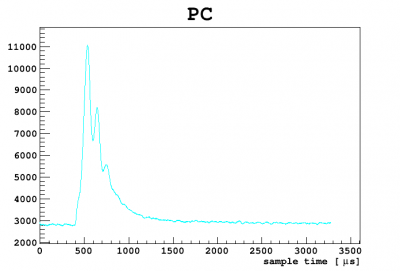
| 1500 | Data looks OK so far, except DIB1pC pulses have 1 kHz “wiggles”, usually manifesting as a second peak but sometimes multiple peaks are seen. Is this phase separation? |
| DIB1pC (Side1pD) pulse example with wiggles |
|---|
 |
| 1655 | Fill LN2 cold trap bath |
|---|---|
| 1715 | Main bath = 85.8% |