2016/03/08 (Tuesday)
| Setup: iZIP mode, DIB1/2/3 → cables → 3.2 MHz filters → DCRC55/33/50 | |
| Idle overnight, DCRCs powered | |
| 0835 | Tower = 31.4 mK, Still = 0.090 mbar, G1/G2 = 125/130 mbar, 1K Pot = 1.54 K / 3.8 mbar, Main bath = 52.0% |
| 0840 | Fill LN2 cold trap Dewar |
| 0840 | Zap SQUIDs |
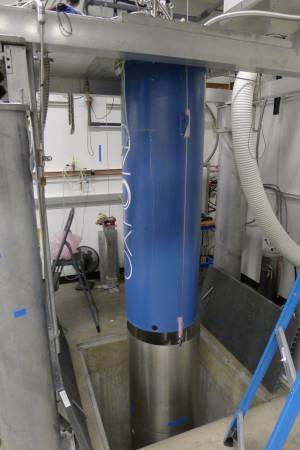
| 0900 | Use hoist to lower mu-metal shield down below cryostat into the pit. Untied and removed the ropes that normally hold the shield to the cryostat. Wrapped hoist cables in bubble wrap where they contact cryostat or fridge frame to keep fridge electrically isolated. |
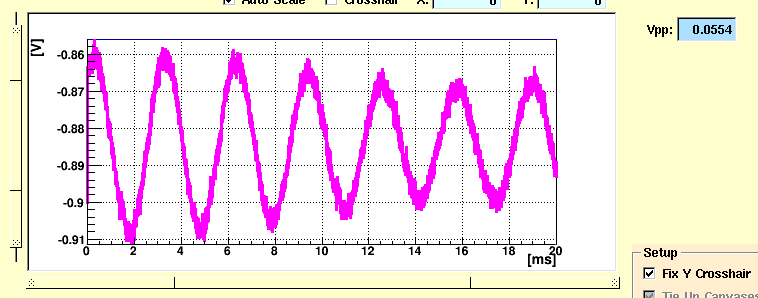
| 0915 | Set QET biases to standard values and restore all phonon channels so that pulses are seen. 330Hz noise seen in DIB1pC, inverted pulses seen in DIB2pA. |
|---|---|
| 0925 | Change DIB2pA QET bias from -112.6 to -120 uA. This gets rid of the upside-down pulses. |
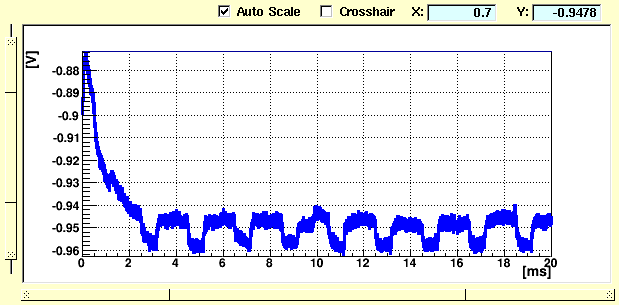
| 1100 | While performing mini IbIs on DIBs 1-3 with DSUB pi-filters and mu-metal shield lowered, notice that DIB3 pA was set to the wrong FrontEnd Gain and Driver Gain. While modifying those values, the channel again began experiencing the fat white noise. Power off DCRC3 and let it sit for a minute while the fridge recovers from the related temperature spike. |
The TES powers derived from the mini-IbIs are slightly smaller in the no-shield case, by 1.5 ± 1.5 pW. Removing a few outliers (DIB2pA, DIB3pA, DIB3pD) reduces the apparent parasitic power to 0.8 ± 0.6 pW.
| 1120 | Repower DCRC3. Now seeing some high-frequency noise on DIB3, and it's hard to get the Driver Offset set properly to view the traces. Also while using the web-based SQUID settings tool, the values for SQUID Bias and Lockpoint on DIB3 pA were set to duplicated values of DIB3 pB. The issue may not lie with the SQUID Tuning GUI. |
|---|---|
| 1130 | Unpower DCRC3 again and let it cool down for longer this time. |
| 1145 | Repower DCRC3. |
| 1205 | All the channels on DIB3 were railed, but adjusting the Driver Offsets brought them back and there's no fat white noise. |
| 1215 | While investigating other channels in preparation for Tc measurements, DIB1 pC has ~50mVpp 330Hz sinusoidal noise on it. This is now present on all DIB1 channels. Unpower all DCRCs and allow fridge to cool (was settled at ~33.5mK which is a little high). |
| 1225 | After repowering the boards, and zapping the SQUIDs, the sinusoidal noise is still present on DIB1 channels, and some sharkfin noise is present on DIB2 pB and DIB3 pB. Unpower boards for longer this time. |
| 1310 | Repower boards, zap SQUIDs, but the sinusoid won't go away. Maybe it's because the mu-metal shield is down? Time to just bull forward regardless. QET biases have all been set to 0, so send 10mVpp triangle waves down the channels to measure Tc's. |
| 1315 | While forging ahead and sending triangle waves down DIB1's QET lines, the fridge temperature spikes up to ~90mK. When investigating DIB3's phonon traces, the fat white noise has shown up again. Unpower DIB3 and allow temperature to settle. |
| 1525 | DIB3 high-frequency noise returned, spontaneously it seems, with heating of fridge - temp rose to 60 mK then fell then rose again to 55 mK then settled at 38 mK, clearly elevated. |
| 1530 | Tightening the connection between the DSUB connectors for DIB3 railed the phonon channels, but after adjusting the Driver Offsets, we no longer saw the fat white noise. Tighten the connections for all 3 DIBs for good measure. It was also noted that all the SQUID Bias and Lockpoint settings on DIB3 had been set to the same values, and only the web-interface for SQUID setting was used. |
| 1545 | All the channels are alive now, though some of them still have uncharacteristically high in magnitude Driver Offsets. And DCRC3 began showing some of the 330Hz sinusoidal noise. |
| 1720 | Finish measuring Tc's of all DIBs. |
| G106a Tc | Tower temperature (mK) | |||
|---|---|---|---|---|
| heating | cooling | |||
| Channel | s/c→trans | trans→normal | normal→trans | trans→s/c |
| DIB1 pA | 85.5 | 87 | 86.5 | 84.8 |
| DIB1 pB | 85.9 | 87 | 86.6 | 84.9 |
| DIB1 pC | 85.9 | 86.3 | 86.3 | 85.0 |
| DIB1 pD | 83.6 | 84.4 | 84.4 | 83.0 |
| DIB2 pA | 82.1 | 84.6 | 84.3 | 81.0 |
| DIB2 pB | ? | ? | 90.0 | 86.8 |
| DIB2 pC | 85.2 | 87.8 | 87.8 | 85.0 |
| DIB2 pD | 82.5 | 83.2 | 82.8 | 81.5 |
| DIB3 pA | 80.3 | 83.9 | 84.0 | 81.5 |
| DIB3 pB | 80.7 | 82.1 | 82.2 | 78.4 |
| DIB3 pC | 83.5 | 85.0 | 84.9 | 82.1 |
| DIB3 pD | 88.3 | 88.6 | 88.4 | 87.7 |
| No mu-metal shield present | ||||
| Italicized values are approximate | ||||
If we take the Tc to be the average of the s/c→trans and normal→trans values (1st and 3rd columns) and compare the no-shield case to the shield case, we find no significant difference. No-shield Tc values are higher by 0.1 ± 0.8 mK. If we remove four outliers (DIB1pB, DIB2pA, DIB2pC, DIB3pA), the no-shield Tc values are higher by 0.6 ± 0.4 mK. We don't expect the Tc values to be higher with the shield present, if anything they'd be lower.
Comparing the mini-IbIs results to this, there is some evidence that two outlier channels may be susceptible to the lack of a mu-metal shield. DIB2pA and DIB3pA have lower Tc's (-.3/-1.4 mK) and significantly higher parasitic powers (5/4 pW). These are two adjacent quad channels: Side2pB and Side2pC.
| 1730 | Fill LN2 cold trap full. |
|---|---|
| 1735 | Commence LHe transfer (34.7%). |
| 1805 | Cease LHe transfer (92.1%). |