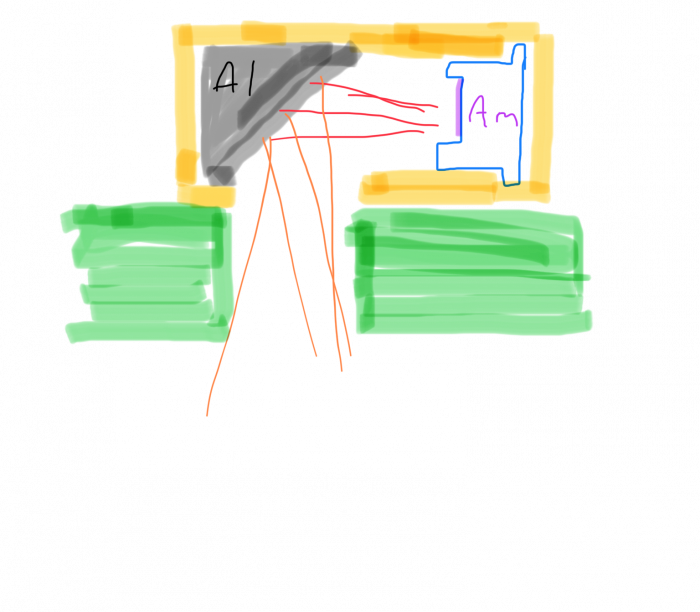
Am-Al fluorescence source
Aluminum has a fluorescence line at 1.49 keV. If we shine our Am-241 source on an aluminum target we can produce this line.
But the Am-source photons are much higher in energy than the Al fluorescence photon and this presents a problem, because the Am photons penetrate much deeper into an Al target than the thickness through which a 1.5 keV x-ray can escape.
| Photon energy [keV] | Al attenuation length [μm] |
|---|---|
| 1.5 | 0.9 (or 10.5?) |
| 9.7 | 123 |
| 14 | 344 |
| 18 | 695 |
| 60 | 14000 |
An x-ray just below 1.5 keV can travel much farther (10.5 μm) through aluminum than one just above 1.5 keV. This is of course because in the latter case the photon can excite a K-shell electron to a higher level, but a lower-energy x-ray cannot do this so the aluminum is more transparent to it. So if we produce a Kα x-ray, how far can it penetrate the aluminum? I think it's 10.5 μm.
That means only a 10 μm outer layer of the Al target is relevant for emitting the desired x-rays. (Or more precisely a few times 10 μm.) But the higher energy photons from the americium source are not likely to interact in such a thin layer. Roughly speaking there is an efficiency factor equal to the ratio of the attenuation lengths between the fluorescence photon and the americium source photon. Therefore the lowest Am-source line (Au, 9.7 keV) is around 10% efficient at producing Al fluorescence; the stronger 14 keV line is around 3% efficient, and the strongest 60 keV line is only 0.07% efficient.
To increase the rate we'd probably want to remove the collimator from the smoke-detector Am source, which would increase the rate by roughly a factor of 25. We would not want to point the source directly toward the detector because the 60keV rate would be too high. So we probably want a reflector setup.