−Table of Contents
Update
- Simulation Data.
Plans
- Run simulation with detector length ~2.5“.
- Print casing for Sodium Iodide detector.
HPGe Boron Shield
Detector setup
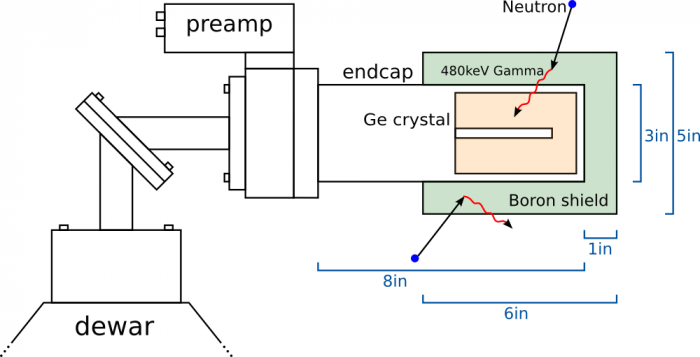
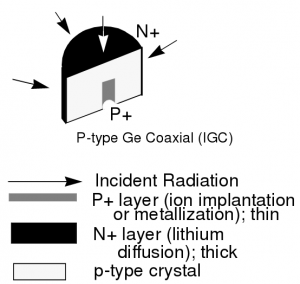
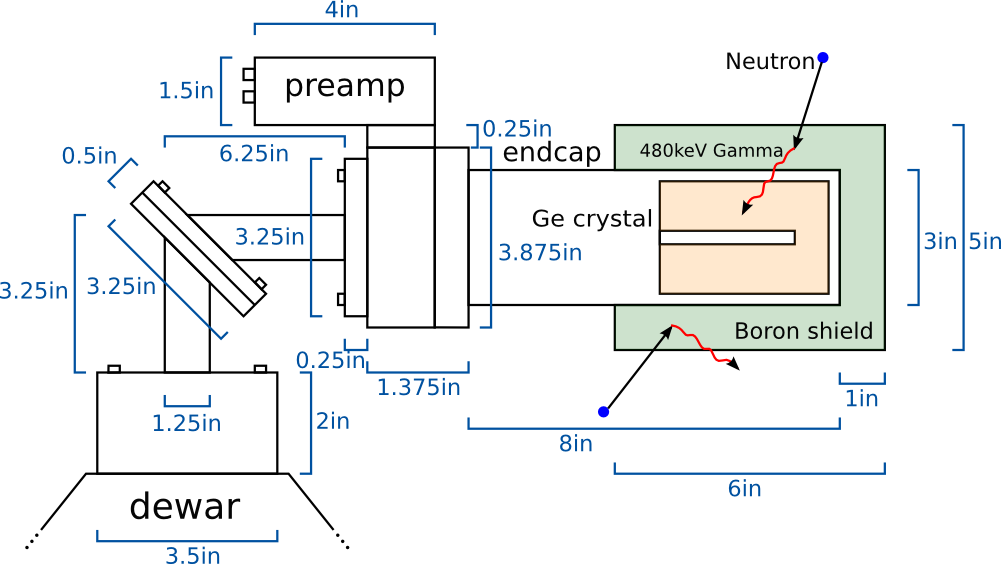
We use a P-type coaxial High Purity Germanium (HPGe) detector with a cylindrical Boride filled shield. Figure shown below.
Detector Size Measurement
We ran the detector with a 133Ba source on the other side of a ~1/4 in gap made with lead bricks. The data was recorded for 15 min and then the detector was moved (along its cylindrically symmetric axis) and this was repeated.
- z represents the distance out from the base of the endcap.
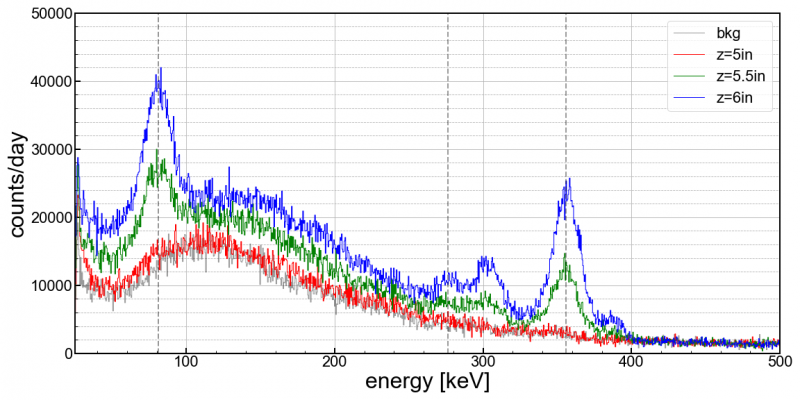
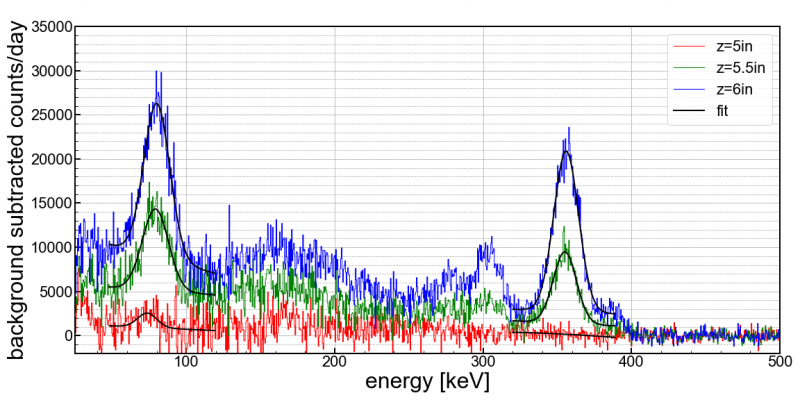
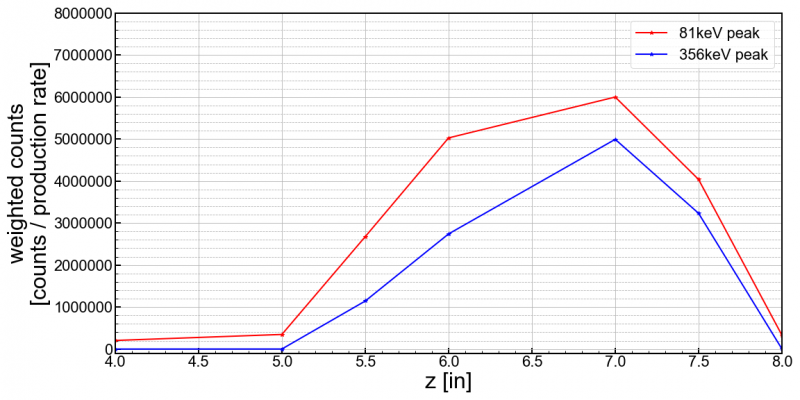
- Now we plot the total counts from each peak together.
- The plot is weighted by the production rate of the source (81.0keV is produced 34.06% of the time and 356keV is 62.05%).
Detector Efficiency Test
To test the accuracy of the efficiency plot given in the user manual, we ran the detector with the 133Ba source placed 8in from the end of the detector
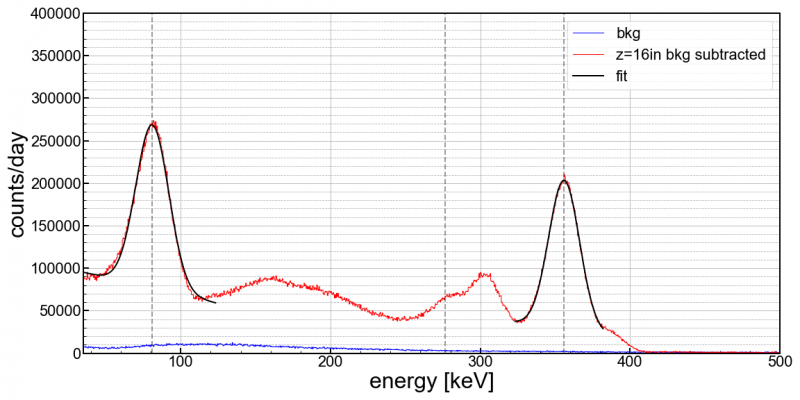
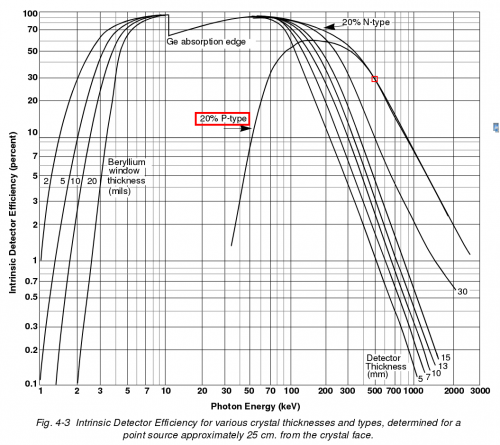
- The 81.0keV and 356keV peaks can clearly be seen.
- After calculating the production rate of the source and the geometry of the setup, the efficiency of the detector is estimated to be 98% for the 81keV peak and 46% for the 356keV peak.
This result matches with an N-type coaxial detector but not a P-type.
First run
Data taken over ~2.75 days with Plutonium/Beryllium source, with and without Boron shielding.
- Energy scale calibrated from a 22Na source.
- There is a 511keV peak from pair production background and a 477keV peak from neutron captures within the Boron shield.
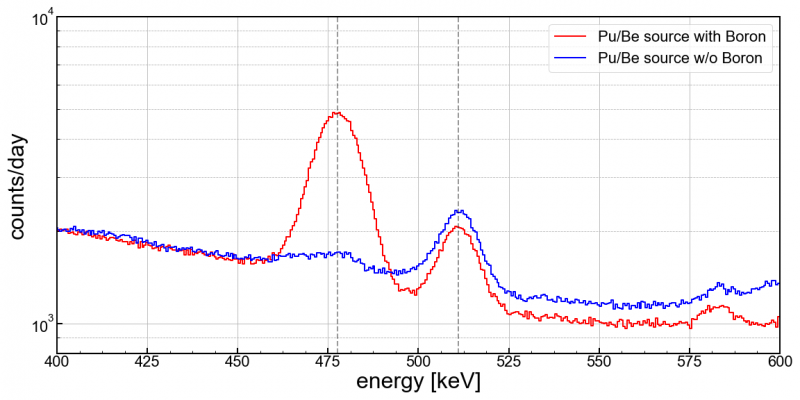
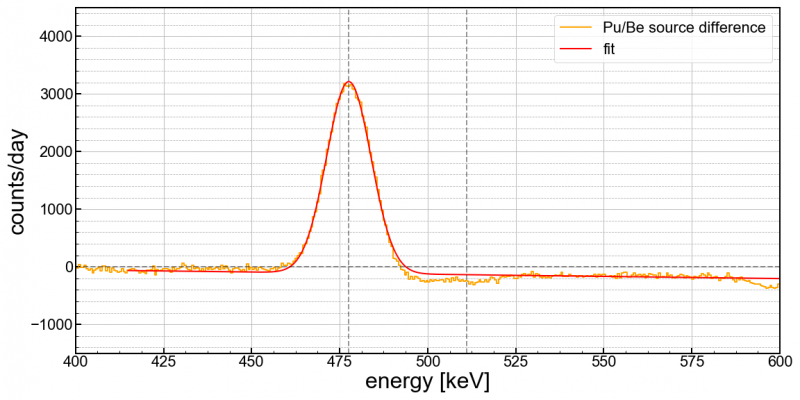
From a Gaussian fit of the peak, A total of ~95,000 counts/day is estimated.
Efficiency estimate
From a rough estimate of the geometry, we expect to have measured ~190,000 counts/day. The Calculation is shown below.
HPGe Boron Simulation
Anthony has updated the “k100Sim” so that it can simulate a situation where the South Wall of the K100 shield is removed (that was the wall where we mounted the NaI detectors). In the place of that wall we have the dewar and HPGe setup with the ability to add/remove the Boron shielding.
The data from a first run of 790M primaries of the Pu/Be source in the barrel position of Run 68 is here (Note: this is with HPGe length of 3 3/8”) :
/data/chocula/villaa/k100Sim_Data/boron/Run68_boron_PuBe_0x0000_1M_*_000_000.txt
This data has the format where each of the columns are as such below:
EV DT TS P Type E1 D3 PX3 PY3 PZ3 X3 Y3 Z3 time3 PX1 PY1 PZ1 X1 Y1 Z1 time1 nCap
The definitions are:
| Simulation and Hit Parameter Definitions | |
|---|---|
| Column Name | definition |
| EV | Event Number within sim execution (Caution! not continuous throughout dataset) |
| DT | Detector number (1:SuperCDMS detector; 1003:HPGe; 1004: boron powder; 1005: boron container) |
| TS | trackstep (track*100000 + step) |
| P | parent track |
| Type | Geant4 particle type (22: gamma, 11: electron, -11: positron, 2112: neutron, AA0ZZ: nucleus with AA mass number and ZZ atomic number, 74032 is 74Ge) |
| E1 | Energy (MeV) |
| D3 | deposited energy (MeV) |
| P[X,Y,Z]3 | post-step X/Y/Z momentum |
| [X,Y,Z]3 | post-step X/Y/Z location |
| time 3 | post-step time (nanoseconds?) |
| next 7 parameters | pre-step copies of the ones before |
| nCap | 0 or 1 depending on whether this hit was a capture or not |
Here is an example of a Macro for the “k100Sim” that can do this:
#make a generic generator
/gps/particle neutron
#/gps/position 0.0 1197.31 -565.15 mm
#updated position for in-barrel source
/gps/position 0.0 1197.31 -646.79 mm
/gps/pos/type Point
/gps/ang/type iso
/gps/ene/type Arb
/gps/hist/type arb
/gps/hist/file sources/pube_skim.dat
/gps/hist/inter Lin

/CDMS/Zip1/IsGe False
/CDMS/detector/activate Walls
/CDMS/detector/activate Floor
/CDMS/detector/activate Frame
/CDMS/detector/activate IceBox
/CDMS/detector/activate PuBeSourceAndShield
/CDMS/PuBe/Barrel True
/CDMS/detector/activate Shields

#this is needed to place the HPGe detector on the South wall
/CDMS/Shield/HPGeboron True
#this is needed to put the boron case shielding around the HPGe
/CDMS/Shield/HPGeboron_shield True
/CDMS/updateGeometry
#run naming stuff
/run/k100/OnlyNCapOut false
/run/k100/OFPrefix /where/you/want/the/files/prefix_
/run/beamOn NEVENTS
From the simulation:
- Number of events with neutrons passing through shield: 169864
- Total number of neutrons captured by shield: 73542 (43% of above number)
- Number of events with gammas produced from neutron capture: 68917 (93.7% of above number)
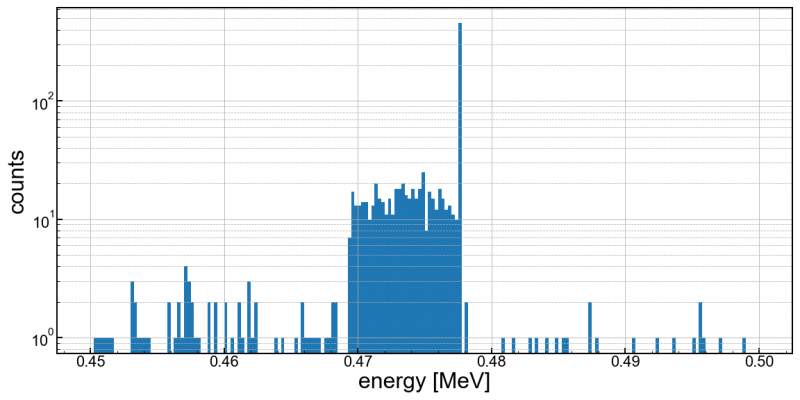
- Number of events with energy deposited into HPGe within energy range (0.45-0.5 MeV): 1020 (1.5% of above number)
We obtain the correct result (~94%) for the production probability of gammas.
Using 1.5% as the geometrical and detector efficiency, the shield efficiency estimate becomes ~ 125%.
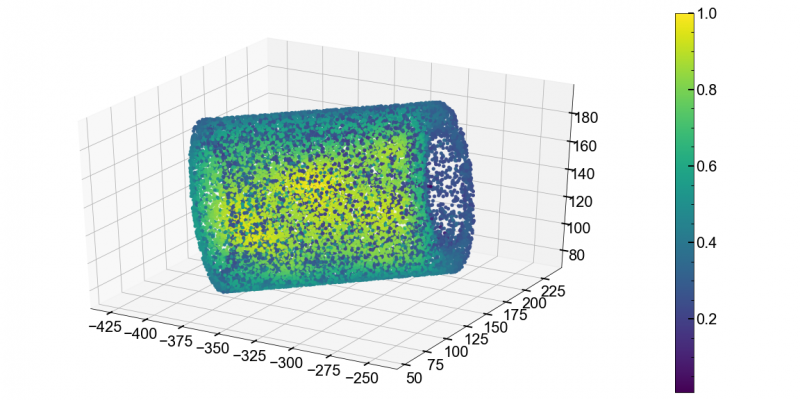
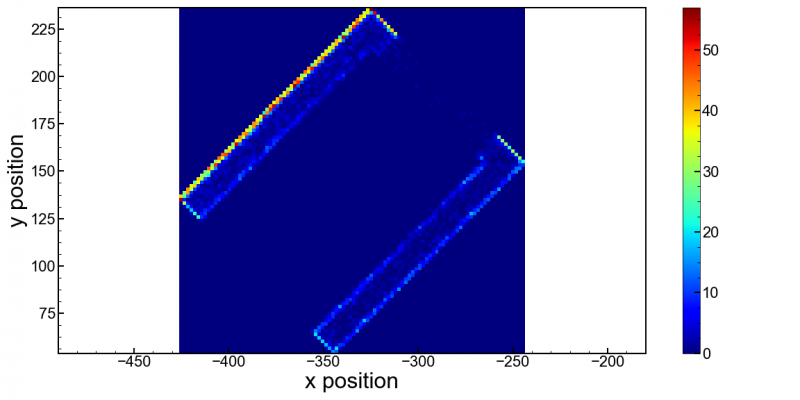
Below is a plot of the Neutron captures in the Boron powder. Colored by density of points.
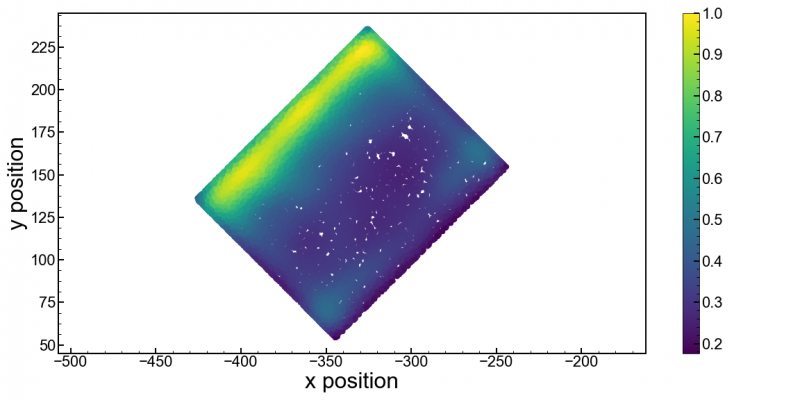
Taking the cross section of 120<z<140 (plot changed to histogram to more accurately show distribution).
Below is a histogram of the simulated deposited energy into the HPGe detector.