−Table of Contents
New shield and upgrades from ARRA
Google SketchUp drawings:
- Most recent, zipped figs with dimensions
Based on the note Geant4 MC comparison of Gopher shielding types, background level can be lowered 10 times, i. e. be 0.2 counts/keV/kg/day @ 500 keV, if we use as the inner layer
- 2“ of Pb with 3 Bq/kg of Pb-210 OR
- 2” Pb (16 Bq/kg) & 1“ Cu.
Keep in mind that the following assumptions have been made in our MC study:
- the only source of contamination in lead is Pb-210
- no contamination in copper at all, i.e. ideally clean Cu
Thus, 2” of Pb (3 Bq/kg) is more realistic. Price from Plombum is 191*1.37=$262 per brick
Based on our simulations, the lowest sensitivity can be achieved if we use 2“ of 0.3 Bq/kg lead. However, the best price of 600*1.37=$822 per brick from Prisca's source makes this solution unaffordable.
Almost comparable decrease in background can be achieved with 2” Pb (3 Bq/kg) & 1“ Cu. This combination is predicted to obtain <0.1 dru and also significantly attenuate Brem comparing to the inner shield without copper. We are working on MC to estimate the background due to Co isotopes from cosmogenic activation in Cu. We are also working on estimating the attenuation that can be achieved with 2” thick copper instead of 1“ thick. Price estimate for this setup is the following:
- 2” most inner OFHC copper:
I've talked to several copper supplier companies and there are several things to note:- they don't have any information on how long time ago their copper was produced. Copper is not produced in US (at least for companies that I've talked to), thus, it can easily spend a year above the ground after it was manufactured
- What companies get are copper plates of various thicknesses and bars. They can cut to any size. They don't have bricks directly from manufacturer, but can cut plate to make bricks. Usually, they don't polish or clean cuts.
 We would like to get a price quote for Oxygen-Free-High-Conductivity copper,
highest purity grade 101.
We would like price quotes separately for each of the two configurations specified below.

Could you please also estimate transport cost to
116 Church Street S.E.
Minneapolis, MN 55455

------------------
Quote #1
- one piece 16" x 16" x 2"
- one piece 24" x 24" x 2"
- one piece 16" x 11" x 2"
- one piece 12" x 11" x 2"
- two pieces 14" x 11" x 2"
- one piece 9.5" x 3.1" x 2"
- one piece 5.5" x 3.1" x 2"
- two pieces 7.4" x 3.1" x 2"
- one piece 9.5" x 9.4" x 2"

------------------
Quote #2
- one piece 16" x 16" x 2"
- one piece 24" x 24" x 2"
- one piece 16" x 11" x 2"
- one piece 12" x 11" x 2"
- two pieces 14" x 11" x 2"
- two semi-circles with 4.7" outer radius, 2.7" inner radius, and 3.1" thickness
- one disk 4.7" radius and 2" thickness
Quote #1 (left) and Quote #2 bottom cap not shown (right):
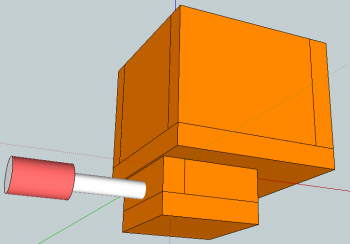
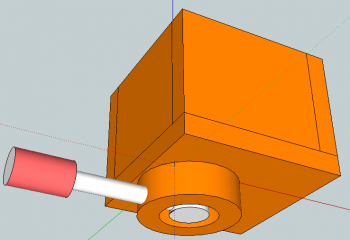
Price quote from Southern Copper is ~7350+[labor to make semi-circles] for Quote #2.
If we want parts to be cut from thicker plates, then the next option is 2.5“. They also cut +1/8” to the size, this is basically their precision. Copper comes from Germany.
- Lead bricks with <3 Bq/kg content of Pb-210:
Price quote from Plombum for 60 bricks is 12487*1.37=$17107. If we decide to go with 2“-thick copper, we would need more bricks.
Should we use 2” of copper or 1“? From G4-MC simulations, assuming ideally clean copper, activities at 400 keV are:
- ~0.06 dru for 2” Pb (3 Bq/kg) & 1“ Cu
- ~0.008 dru for 2” Pb (3 Bq/kg) & 2“ Cu
Suppose activity from cosmogenic activation in Cu will give 0.05 dru for 1” thick copper. If we use 2“-thick copper, outer copper 1”-thick layer will deposit only 12% (calculated for 400 keV for Cu (r=0.094 cm^2/g)) of activity due to shielding by inner 1“-thick copper layer. Thus, for copper with some cosmogenic activation, we expect:
- 0.06+0.05=0.11 for 2” Pb (3 Bq/kg) & 1“ Cu
- 0.008+0.056=0.064 for 2” Pb (3 Bq/kg) & 2“ Cu
Overall, our maximum limit for just material purchasing is ~$46.5K and we are below it.
Action Items
- Buy Cu bricks (Prisca)
- Design brick placement (Oleg)
In progress…
We need to know how many old lead bricks we can afford to buy. - Start discussions with Jim Reeves (Prisca)
- Have Jim start/finish LN refill system (Jim, Prisca)
- Talk to shop about design concept of inner lining and door (prop ID: asset ID number is FAB201009005) (Oleg)
- From the proposal the goal is to have 0.5” thick Electroformed Cu liner, machined and formed into a 8” x 14” x 14” box with a removable, split bottom and door.
- What's the size of the largest ECu piece that can be produced?
- This time we indeed make a box with the top.
Buy S-6500 (Oleg) Contact Kevin Roberts (kroberts @ physics.umn.edu) to handle invoice. Canberra will ship it to Soudan at the end of May.
We have it.
Manual for S-6500.
New shield: questions to consider
- Copper: what contamination do we worry about?
- cosmogenic activation:
- primordial and manmade:
- Lead: do we worry only about Pb-210 contamination?
- Consider several shield configurations
- Want to have 12“ of lead in all directions. This includes ancient lead.
- First version of built Gopher's shield has used ~900 lead bricks. One standard Pb brick weights ~12 kg.
- We have a question about Gopher's door (copper plate) that will be sliding horizontally on rails. Copper plate is 32”-by-26“ with 26”-side being parallel to the rails. What is the minimum possible thickness of the copper plate to safely support ~1,248 kg of lead distributed evenly on top of it?
Wish-list from experience with Gopher so far:
- No almost-direct line-of-sight cracks.
- Walls near the “door” should have L-shape to eliminate direct line-of-sight crack.
Copper companies:
Survey of shield designs used by others
Gopher at Soudan:
at least 12“ of Pb in any direction, 3/8” of Cu.
Gator at Soudan:
GATOR was installed inside a thick Lead shield (roughly 9“ of newer Lead and 2” of ancient Lead) deep in the Soudan.
Gator at LNGS:
from inner to outer: 2“ of Cu, 2” of 3 Bq/kg Pb, 6“ of Pb.
SOLO at Soudan:
The detectors are housed within a single Pb shield with thickness of > 30 cm on all directions. The shield was initially constructed with 2 chambers, in order to house 2 detectors, but it has been rebuilt to have a single large chamber in May, 2007. The Pb shield is build with ~10 tonnes of Pb bricks sized 2 in x 4 in x 8 in, with activity of 50 Bq/kg. An 2”-thick inner liner of 200 year old Pb bricks with low 210Pb activity, estimated at 50 mBq/kg, has been added to the cavity to further reduce the background.
Misc.
Some points in the proposal:
- Detector's sensitivity limitation: poor shielding vs. detector/ cryostat problem. With the proposed shield rebuild with Cu bricks the most convincing argument would be to buy a few bricks and stack them around detector's can.
- Load lock sample-changing mechanism. With our current sensitivity I don't see any of Rn-222 decay lines 4 hours after the “door” was opened and the cavity was purged with the increased N2 flow. Does anybody else have it?
- Lynx DSA. Talk to PNNL about their experience with it?