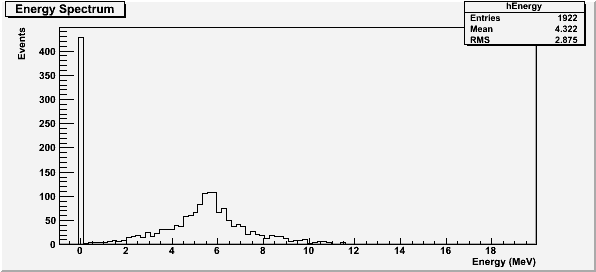
PMTs 0 and 3 were placed 6.5 cm apart vertically against the telescope scintillator with PMT 14 between them against scintillator 1-66-?. PMT biases were varied between -1100V and -1200V. PMT 14 was triggered by a coincident event from PMTs 0 and 3. The coincident event was defined by a threshold of -25 mV with a 70 ns coincident window. The telescope was configured such that the the middle scintillato (1-66-?) was parallel to one of the telescope scintillators, and the second telescope scintillator was perpendicular to both (while remaining parallel to the ground). The total time run and the number of events varied by trial.
| Table 1: Data Files used. |
| Run | Date | Gain (V) | Number of Events | Total Time (s) | Data File |
| 1 | 2013/11/15 | -1100 | 3261 | 250863 | 1115-1118_cross_1100v_6.5cm.dat |
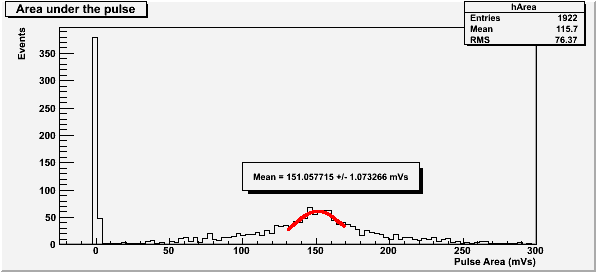
| 2 | 2013/11/24 | -1200 | 1922 | 168526 | 1124-1126_1200v-all_cross_6.5cm.root |
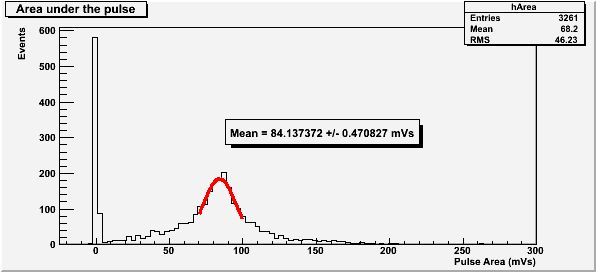
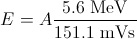
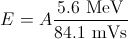 ,
 is energy in MeV and
 is pulse area in mVs.
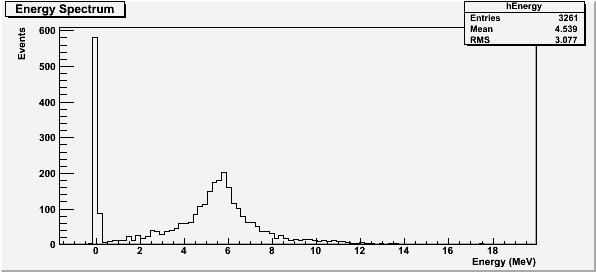
 ,