First Runs with Na-22
The Na-22 source was placed between two scintillators such that one of the back-to-back 511 keV gammas released is detected in one of the scintillators. A coincident trigger is used between two 2“ PMTs. PMT R1332 (ch 0) was coupled to the sample scintillator and PMT 8575B to the square scintillator.
| Table 1: Data Runs |
| Run | Date | Sample | Source | Number of Events | Total Time (s) | File |
| 1 | 2015/01/15 | Gd-loaded (1-101) | Na-22 | 30001 | 1351 | 20150115_na-22_test.dat |
| 2 | 2015/01/19 | no loading (1-74-2) | Na-22 | 30002 | 1333 | 20150119_na-22_test.dat |
| 3 | 2015/01/19 | no loading (1-74-2) | muon | 13000 | 262882 | 20150119_muon_run.dat |
| 4 | 20015/01/22 | Gd-loaded (1-101) | muon | 12217 | 428446 | 20150122_muon_run_gd-scintillator.root |
Non-Gadolinium Loaded Sample
| Figure 1: Area under the pulse with a Na-22 source |
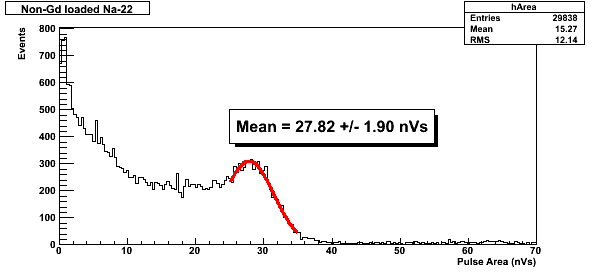 |
From the Na-22 source, the energy of the peak in Figure 1 at 28 nVs should be 511 keV. Assuming a linear response of the plastic scintillator, the 5.6 MeV muon peak should sit at 300 nVs. The muon peak in Figure 2 is instead at 120 nVs.
| Figure 2: Area under the pulse with a muon telescope |
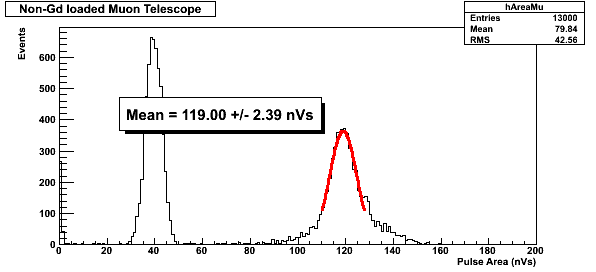 |
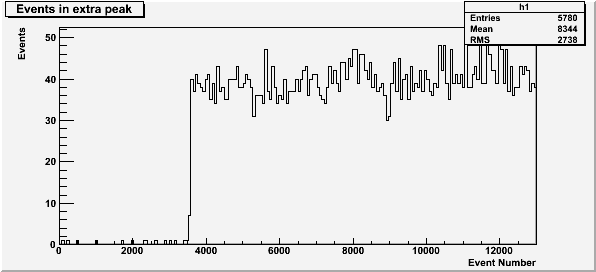
The extra peak visible in Figure 2 is not a muon peak. Figure 3 shows how this peak appears midway through the run.
| Figure 3: Look at strange muon peak |
 |
Gadolinium Loaded Sample
| Figure 4: Area under the pulse with a Na-22 source |
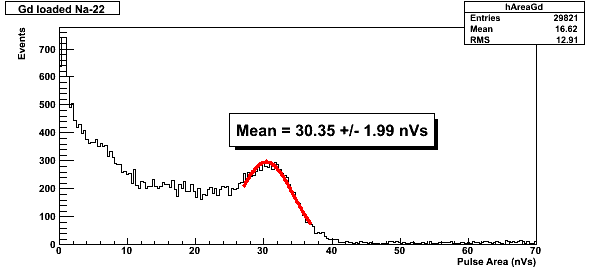 |
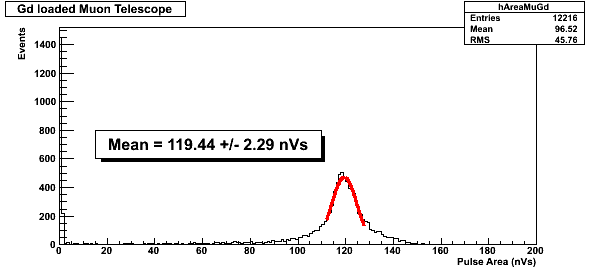
From the Na-22 source, the energy of the peak in Figure 4 at 30 nVs should be 511 keV. Assuming a linear response of the plastic scintillator, the 5.6 MeV muon peak should sit at 330 nVs. The muon peak in Figure 2 is instead at 120 nVs.
| Figure 5: Area under the pulse with a muon telescope |
 |