−Table of Contents
Quantum Efficiency Measurements
Issues
- SiPM doesn't give good results
- No known gain for PMT so anode responsivity cannot be converted to quantum efficiency
- Is there a way to measure cathode responsivity directly?
- How can we measure the gain of the PMT?
Procedure
The experimental setup shown in Figure 1 was used.
| Figure 1: Experimental Setup |
|---|
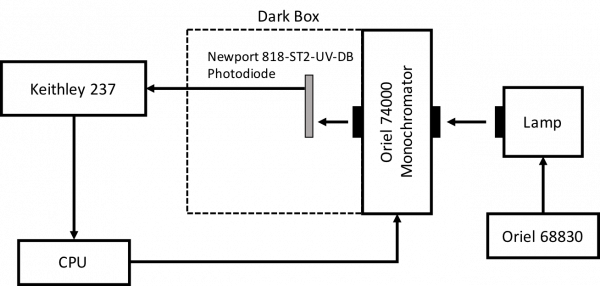 |
| A bias of 1.75 V was applied to the lamp. The photodiode was operated in photovoltaic mode. Data was collected from 200nm to 800nm in 1nm increments, with a settling time of 1 second. |
As the Newport photodiode has a known responsivity calibration file, at each wavelength, the power emitted by the lamp could be determined from the measured current, as shown in Figure 2.
| Figure 2: Power spectrum of white light source |
|---|
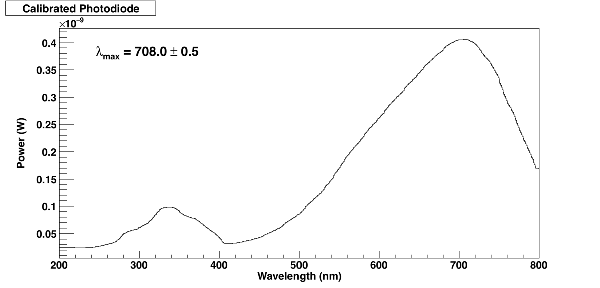 |
| This data was converted into watts using a the Newport photodiode calibration file and the spline method to interpolate points between known calibration points. |
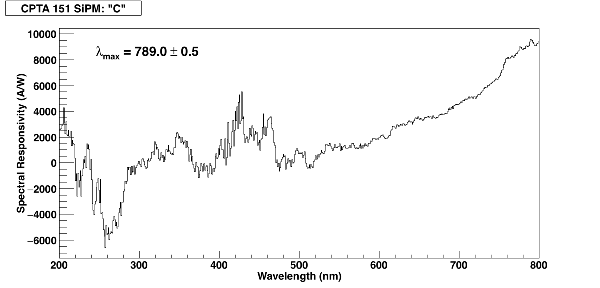
The photodiode was then replaced with a SiPM, to which the Keithley unit applied a bias of 20.80V, the same as that is applied by the TB4 board. The measured current at each wavelength was divided by the known power at that wavelength (measured by the photodiode) to obtain the anode responsivity of the SiPM. These results are shown in Figure 3.
| Figure 3: Spectral responsivity of SiPM C |
|---|
 |
| This data was converted into watts using a the Newport photodiode calibration file and the spline method to interpolate points between known calibration points. |
| Figure 4: Experimental Setup 2 |
|---|
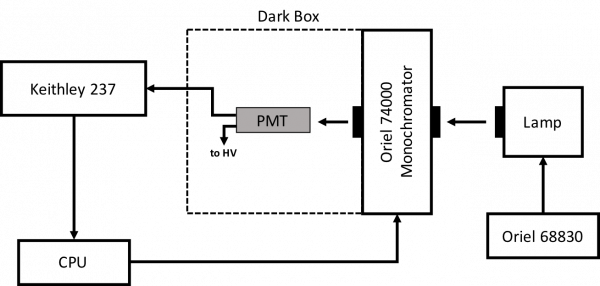 |
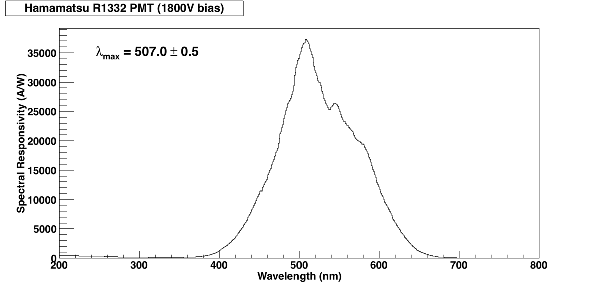
| This setup was used to measure the anode spectral responsivity of a PMT. |
| Figure 5: Spectral responsivity of 2“ Hamamatsu PMT R1332 |
|---|
 |
| This data was converted into watts using a the Newport photodiode calibration file and the spline method to interpolate points between known calibration points. |
Using Equation 1,
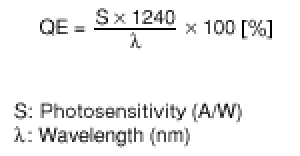 ,
where 1240 is h·c·e-1 in eV*nm (https://www.hamamatsu.com/us/en/support/glossary/c/index.html), the cathode radiant sensitivity (S, in units of A/W) can be converted into a quantum efficiency.
Sources:
Newport 818-ST2-UV/DB Photodiode
Specs:
Hamamatsu R1332 PMT
The phototube is bi-alkali, according to https://www.ortec-online.com/-/media/ametekortec/manuals/265a-mnl.pdf.
Sources:
CPTA 151 SiPM
Only available documentation appears to be for 151-30, but it appears the appropriate SiPM bias voltage is about 20V, rather than the 30V indicated by the data sheet.
Appendix A
| Table 1: Measurement Specifications for LabView “GoTo Wavelength Loop-Step 74000 + 237 10.vi” Program | ||||
|---|---|---|---|---|
| Default | Photodiode | PMT | CPTA 151 SiPM | |
| Source range I/V | 1nA/1.1V | auto/auto | auto/auto | auto/auto |
| 1100V Enable | Off | Off | Off | On |
| Bias Level (V) | 0 | 0 | 0 | 20.7 |
| Wavelength Range (nm) | 200.0 to 800.0 | 200.0 to 800.0 | 200.0 to 800.0 | 200.0 to 800.0 |
| Settling Time (ms) | 1000 | 1000 | 1000 | 1000 |
| Step Size (nm) | 1 | 1 | 1 | 1 |