Table of Contents
Run 41
Noisy Charge Signals on DIB 2
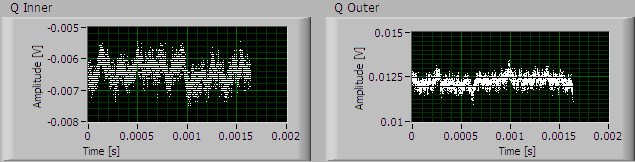
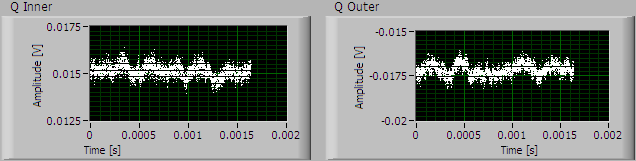
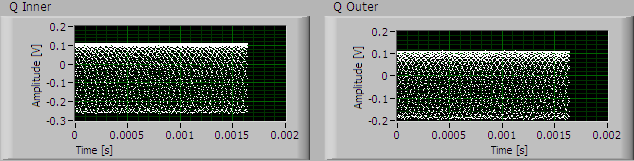
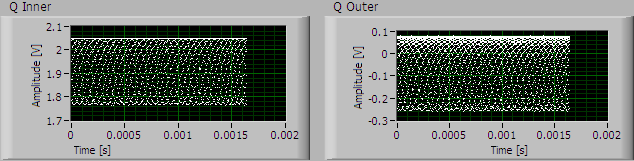
Bench tests on the DCRCs connected to the mini-BOB indicate no problems as shown in Fig. 1. The 15 V power supply and FET heater successfully turn on when the corresponding instructions are sent to the boards. However, when connected to DIB 2 through the feedthroughs on the ebox, the charge signals appear noisy after instructions have been sent to turn on the 15 V power supply and FET heater as shown in Fig. 2. Closer inspection of the signals indicate that they appear to be many intersecting sine waves. The amplitude of these oscillations is around 350 mV, making it impossible to extract any low energy pulses from this DIB. This has never been witnessed before. Both boards behave this way, although a number of attempts are required before DCRC32's 15 V power supply does turn on without immediately cutting out. This has happened in the past and the fault has not been diagnosed despite a number of attempts by Sten. DCRC31 doesn't seem to exhibit this behaviour.
| Figure 1: Charge signals from bench tests where DCRC31 (left) & DCRC32 (right) are connected to mini-BOB. | |
|---|---|
 |  |
| Figure 2: Charge signals when DCRC31 (left) & DCRC32 (right) are connected to DIB 2. | |
|---|---|
 |  |
| Figure 3: Charge signals when DCRC32 is connected to DIB 1. |
|---|
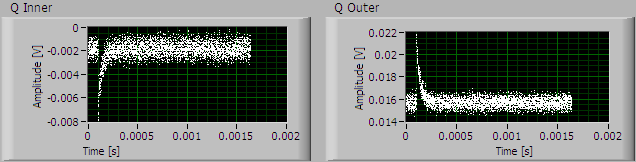 |
Puzzlingly, only connecting DCRC31 to DIB 1 yields good pulses as shown in Fig. 3. DCRC32's 15 V power supply keeps cutting out when connected to DIB 1. Additionally, when DCRC32 is connected to DIB 2 while DCRC31 is attached to DIB 1, there is evidence of cross-talk as DCRC31's charge channels begin to oscillate in the same fashion as shown in Fig. 2. However, the amplitude of these oscillations in DCRC31 is an order of magnitude smaller at around 35 mV. A summary of the observations is given in Table 1 for ease of reading.
| Table 1: Summary of charge channel observations for different DCRC configurations. | |
|---|---|
| Configuration | Observations |
| DCRC31 attached to mini-BOB | No problems witnessed, 15 V power supply and FET heater turn on when requested (Fig. 1). |
| DCRC32 attached to mini-BOB | No problems witnessed, 15 V power supply and FET heater turn on when requested (Fig. 1). |
| DCRC31 attached to DIB 2 | Oscillations of amplitude 350 mV witnessed (Fig. 2). |
| DCRC32 attached to DIB 2 | Oscillations of ampltiude 350 mV witnessed (Fig. 2), 15 V power supply cuts out regularly. |
| DCRC31 attached to DIB 1 | No problems witnessed, pulses look good (Fig. 3). |
| DCRC32 attached to DIB 1 | 15 V power supply keeps cutting out making it impossible to see any pulses. |
| DCRC31 attached to DIB 1 DCRC32 attached to DIB 2 | Oscillations of amplitudes 35 mV and 350 mV witnessed on DCRC31 and DCRC32 respecitively. |
Sten sent two DCRCs (DCRC33 and a Rev. C.1) to us on Friday 1st November. Although we expected these to arrive by the middle of the week beginning Monday 4th November, new requirements from the DoE for loans from Fermilab held them up, and they arrived after the run had been completed, the cryostat warmed to room temperature and the next run had started with G114. As DCRC32 appears to be playing up more regularly, one of the new boards should alleviate this issue. It is expected that this will be tested during a future run with this crystal.
As for why both DCRC31 & DCRC32 exhibit such behaviour when plugged into DIB 2 remains a mystery. As stated previously, this has never been seen before. The FET heater on the SQUET card passes electrical checks and no shorts to ground between the charge channels traces have been found. A potential drop of around 5 V between the FET heater and ground is observed when the DCRCs are plugged into the miniBOB. Although this is lower than 9 V battery on the FEB boards, this has never caused any problems. FET heater+/- checks from the breakout box with everything connected yields a 20 Ohms greater resistance on stripline 19, which is negligible and does not explain why the FET heater appears to turn on for a very short time before cutting out (unsure of this hypothesis). The charge traces rail before dropping to a baseline around 0 V when the FET heater is turned on as expected. During the descent, the charge traces look fine until the baseline approaches 0 V, at which point the oscillations appear.
The oscillations did disappear for a while, for undetermined reasons, but made a reappearance after an overnight bake. The behaviour seems to exonerate the DCRCs as DCRC31's charge signals when plugged into DIB 2 appear to be fine. It was thought that a fault may have developed with the SQUET card, so the cryostat was warmed to room temperature to replace it. The same problem was witnessed, exonerating the SQUET card. The stripline is the last suspect left, and shall be investigated during a future run with this crystal.
Broken Set Screw on Valve V6
Valve V6 is an external valve whose motor is controlled via the IGH. It is a fine control valve that lies between the still and circulation pump. The valve is rather tight, and as a result the set screw holding the shaft to the motor frequently shears off. After talking to the workshop, a hole was drilled through the centre of the shaft and the set screw now lies across the entire diameter. Hopefully, this will be stronger than the previous arrangement and result in better reliability.
Charge Collection Efficiency
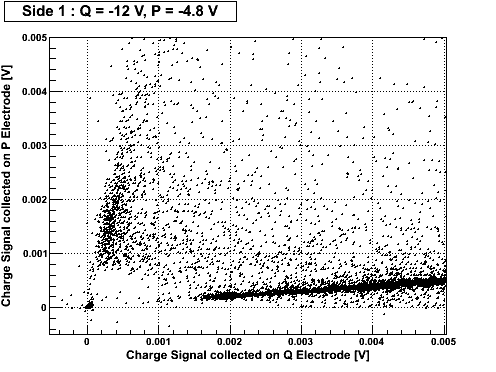
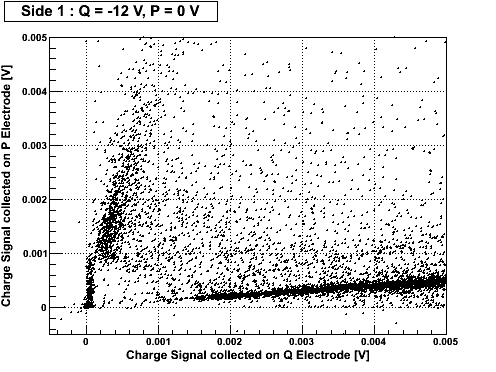
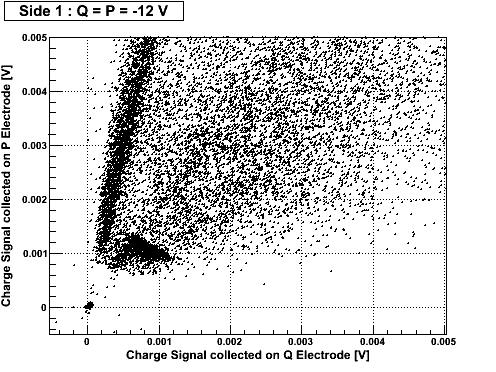
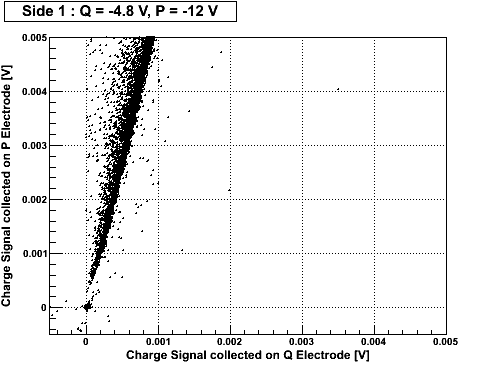
| Figure 4: Charge Signals collected on P as functions of those collected on Q Electrodes. | |
|---|---|
 |  |
 |  |
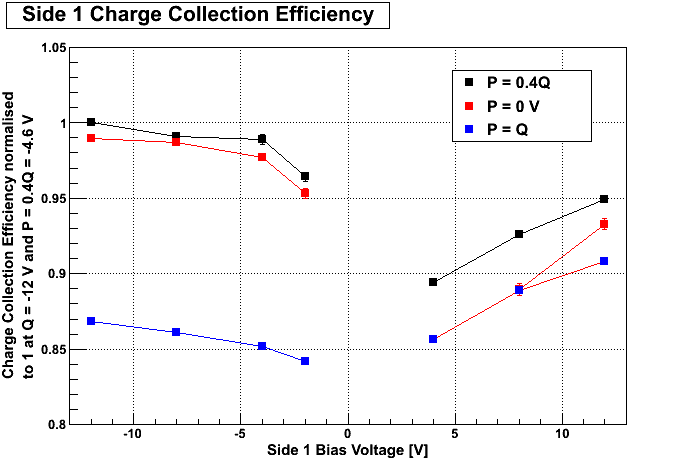
| Figure 5: Charge Collection Efficiency. |
|---|
 |