2021/07/01 (Thursday)
- Lab in-personnel: Matt
| Status | Run 74 in progress. First cooldown after IVC rebuild. |
|---|---|
| Tower thermometer is reading high, probably this is a thermometer problem and the actual temperature is much lower. High noise in some of the charge channels. | |
| Setup: DIB1/2+acc → SL 41/43 → 3.2 MHz filters → cables 2/3 → nothing/Source_mover_board+HV_diverter_board → DCRC50(3)/55(1). Kepco 40V supplye → HV BNC. No lead/poly shield. (actually currently DCRC55(1) is disconnected. DIB2+acc→SL43→filter→cable3→Source_mover_board) | |
| 1125 | Tower/MC/Coldplate = 78.6/31.6/186 mK, Still = 1.33 K / 0.075 mbar / 0 mW, G1/G2= 223/203 mbar, 1K Pot = 1.64 K / 24±2 mbar. MB = 30.9% |
| 1130 | Fill LN2 cold trap bath |
| Yesterday I moved the source till it was close to the near endstop, then moved it in -8-step moves repeatedly looking for a decrease in the Tower temperature spikes which would indicate it had hit the endstop. Didn't see that even though we moved it to what should be 0.66 mm past the contact point. We'll start today by moving it back in the other direction a bit, so that we can start moving toward the near endstop again and have a couple of reference moves so any temperature spike change will be more clear. We'll do this first move sequence with increased driver power just in case it's already stuck. |
|
| 1132 | Do mvNwait +8steps×2times, 3 minute wait, with dwell = 40 and power = 8.8 V. (Around 2.6 mm/hour.) First move: V_trimpot = 8.6 V peak-to-peak, Vpower = 10.2 Vpp. First Tower peak @ 1.43 K, minimum before next spike = 0.83 K |
| 1140 | Second Tower peak @ 1.60 K |
| 1144 | Tower has cooled to 0.45 K |
| 1144 | Do mvNwait -8steps×5times, 3 minute wait, with dwell = 40 and power = 7.2 V. (Around 2.6 mm/hour.) First move: V_trimpot = 6.8 V peak-to-peak, Vpower = 8.0 Vpp. First Tower peak @ 1.39 K, minimum before next spike = 0.92 K |
| Subsequent moves show Tower peaks @ 1.58-1.64 K, minima 1.01-1.05 K. Not seeing any decrease in the spikes. It should now be -1.06 mm past the near endstop. | |
| 1302 | Do mvNwait -8steps×4times, 3 minute wait, with dwell = 40 and power = 7.2 V. (Around 2.6 mm/hour.) First Tower peak @ 1.35 K, minimum before next spike = 0.86 K |
| Subsequent moves show Tower peaks @ 1.54-1.60 K, minima 0.96-1.00 K. Not seeing any decrease in the spikes. It should now be -1.58 mm past the near endstop. | |
| 1405 | “Far” endstop shows contact! Resistance unstable, 200-800 Ω. (Measuring resistance with multimeter is causing temperature spikes. Tower → 0.9 K first time, → 1.4 K second time. Using the meter in the nS setting doesn't seem to heat the fridge. In nS it just reads OL. So this seems to be actually the near endstop but the wire for the far endstop is showing continuity. That probably means on the cold side I have the near endstop plugged into where the far endstop should be, and the far endstop plugged into nothing. |
| 1430 | Do mv +8 with dwell = 40 and power = 8.8 V. This breaks contact with the endstop - good! |
| Do mv -4 with dwell = 40 and power = 7.2 V. This makes contact with the endstop. |
|
| 1554 | Start LHe transfer @ MB = 24.2% |
| 1630 | End LHe transfer @ MB = 88.0% |
| Let's experiment with moving the source using short moves but at one of the same rates we did before. We'll see what average temperature we get, and later we can do a cooling curve to see what this temperature corresponds to in terms of average rate of heat generated by the source mover. We'll monitor the MC temperature, since that's the reference for the cooling curve. | |
| 1702 | MC = 34.6 mK |
| 1705 | Do mvNwait +4steps×20times, 1 minute wait, with dwell = 40 and power = 7.2 V. (Around 4.0 mm/hour.) First MC peak ~ 60 mK, then each peak was higher for a while. Final peak = 149.2 mK. Final minimum between peaks = 145.4 mK. 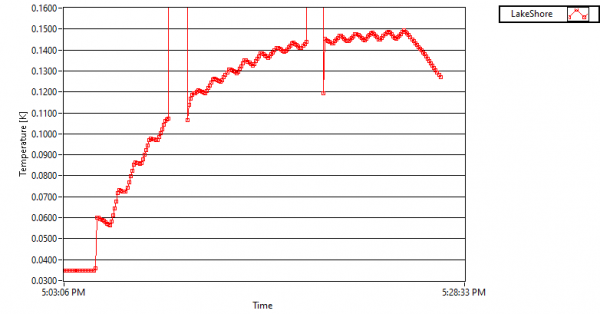 I also checked Tower temperature twice: first time 1.35-1.56 K, second time 1.46-1.56 K Over this 20-minute sequence Condenser pressure rose from 219 to 231 mbar |
| 1750 | Do mvNwait +4steps×30times, 45 second wait, with dwell = 40 and power = 7.2 V. (Around 5.28 mm/hour.) First MC peak ~ 63 mK, then each peak was higher for a while. Final peak = 172.6 mK. Final minimum between peaks = 171.1 mK. Over this 22.5-minute sequence Condenser pressure rose from 227 to 240 mbar |
| 1915 | Tower = 39.7 mK |
| 1917 | Turn on MC heater → 10 μW |
| 1924 | MC has mostly flattened, 67 mK with ~1mK wavering. |
| 1925 | Turn up MC heater → 30 μW |
| 1938 | MC has mostly flattened, 103 mK. Condenser rose 230→231.5 mbar |
| 1939 | Turn up MC heater → 80 μW |
| 2005 | MC has mostly flattened, 161 mK. Condenser → 245 mbar |
| 2005 | Turn up MC heater → 120 μW |
| 2025 | MC has mostly flattened, 192 mK. Condenser → 254 mbar |
| 2030 | Turn off MC heater |
| Cooling curve fit: $ T = T_0 \sqrt{\frac{P}{P_0} +1} $ | |
| $T_0$ [mK] | $P_0$ [μW] |
| 40.8 | 5.6 |
This suggests the following amount of heating from the source mover at the two movement rates used today:
| Movement rate [mm/hour] | Mean temperature [mK] | Heating power [μW] | Heat per distance moved [mJ/mm] | Heat per angle of rotation [mJ/rad] |
|---|---|---|---|---|
| 3.96 | 147.3 | 67.4 | 61.3 | 7.72 |
| 5.27 | 171.9 | 93.7 | 64.0 | 8.06 |
As one might expect the heat per distance moved is nearly the same in the two cases.
Note that the fourth column is in force units: around 60 N, or 14 lbs. If we think of the heat as coming from friction it seems like an awfully large effective linear force to move the source carriage. On the other hand the fifth column is in torque units, 0.008 N*m, and that doesn't seem so large (around 1 pound*inch).