2021/06/28 (Monday)
- Lab in-personnel: Matt
| Status | Run 74 in progress. First cooldown after IVC rebuild. |
|---|---|
| Tower thermometer is reading high, probably this is a thermometer problem and the actual temperature is much lower. High noise in some of the charge channels. | |
| Setup: DIB1/2+acc → SL 41/43 → 3.2 MHz filters → cables 2/3 → nothing/Source_mover_board+HV_diverter_board → DCRC50(3)/55(1). Kepco 40V supplye → HV BNC. No lead/poly shield. (actually currently DCRC55(1) is disconnected. DIB2+acc→SL43→filter→cable3→Source_mover_board) | |
| 1020 | Tower/MC/Coldplate = 86.5/31.8/192 mK, Still = 1.36 K / 0.080 mbar / 0 mW, G1/G2= 219/200 mbar, 1K Pot = 1.64 K / 24±2 mbar. MB = 62.6% |
| 1025 | Fill LN2 cold trap bath |
| We've been moving the source. We've tried to move it until it hits an endstop. The waveforms make it look like it is moving ok, event with many-step moves. But we've gone enough steps that we should be 3.5 mm past the far endstop, and yet there's not measurable contact. | |
| 1040 | Experiment with the spare motor. Connect coils in series with 200Ω resistors and use scope to watch voltages across power supply and resistor for one coil, so V and I as we've been doing with the source mover. Vpower = 11.2 Vpp, Vseries = 6.8 Vpp. Now hold the shaft so it doesn't turn. I can keep the shaft from turning at all, I just feel pulses. Vpower and Vseries unchanged. So extra resistance does not seem to affect the current draw on the motor. |
| 1055 | Reconnect the source mover to the Arduino We'll try moving in the - direction now. Let's operate on the assumption that we've hit the far endstop and we've stopped moving, and we may be jammed. So let's try moving backward but use increased voltage for the driver power. |
| 1102 | Do mv -8 with dwell = 40 and power = 8.8 V. MC rises quickly above 90 mK, then peaks right away. Waveforms: V_trimpot = 8.8 V peak-to-peak, Vpower = 10.4 Vpp |
| 1102 | MC peaks at 95 mK. Tower = 1.36 K and falling. |
| 1107 | Tower falls to 0.7 K |
| Let's do a series of moves in the - direction. We'll monitor the Tower thermometer and see what pattern we get. | |
| 1112 | Do mvNwait -8steps×6times, 4 minute wait, with dwell = 40 and power = 8.8 V. First Tower peak @ 1.52 K, minimum 0.83 K. Later peaks drifted up from 1.64 → 1.70 K, minima 0.91 → 0.95 K |
| Note: looking back at 20191121 it looks like we unjammed the source be increasing the current, not by increasing the power but rather by reducing the trim pot resistances. Let's try some moves in the + direction to see how much the current is affected by changing the bias power. | |
| 1145 | Do mv +4 with dwell = 40 and power = 8.8 V. Waveforms: V_trimpot = 8.6 V peak-to-peak, Vpower = 10.4 Vpp Tower started @ 0.42 K peaks → 1.09 K |
| 1149 | Do mv +4 with dwell = 40 and power = 7.2 V. Waveforms: V_trimpot = 6.8 V peak-to-peak, Vpower = 8.0 Vpp Tower started @ 0.65 K peaks → 1.13 K |
| Suppose we started today jammed against the endstop, and then moved away from it. We moved backwards 56 steps. Then just now we moved forward again 8 steps. So then we'd be 48 steps away from the jammed position now. Let's try a sequence of forward moves, 9 moves @ 8 steps each. | |
| 1158 | Do mvNwait 8steps×9times, 4 minute wait, with dwell = 40 and power = 7.2 V. |
| 1240 | The last three moves did, indeed, show lower temperature increases! 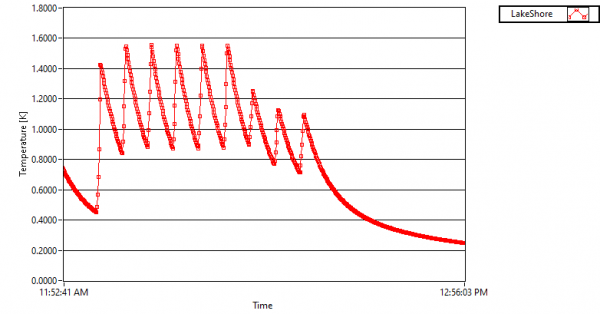 |
| Let's try again, going further backwards this time, then move forward again, see if we can repeat this. We'll increase the driver bias again in case we need to unjam the source carriage. | |
| 1454 | Do mvNwait -8steps×9times, 4 minute wait, with dwell = 40 and power = 8.8 V. First Tower peak @ 1.48 K, minimum 0.81 K. Later peaks drifted up from 1.62 → 1.69 K, minima 0.89 → 0.96 K |
| 1547 | Do mvNwait +8steps×12times, 4 minute wait, with dwell = 40 and power = 7.2 V. |
| 1635 | We get the expected result: again the last three moves show reduced temperature spikes compared to the first 9 moves. Good! 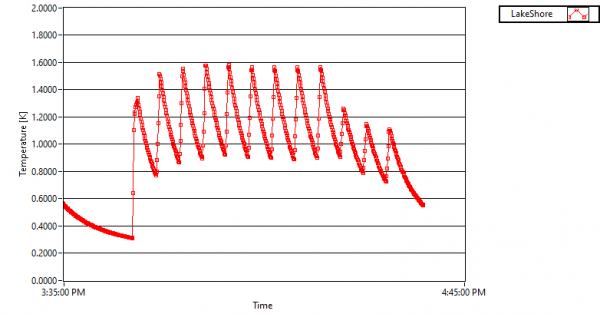 |
| OK - now it would be good to verify that long moves are as efficient as sequences of short moves. But actually - isn't this already verified by the fact that we wound up close to the far endstop, with mostly 128-step moves? | |
| instead - let's try to move all the way to the near endstop, with long moves. First, let's do a shorter moved with the higher bias 8.8V - then we'll switch to longer moves with 7.2 V | |
| 1656 | Do mv -32 with dwell = 40 and power = 8.8 V. Waveforms: V_trimpot = 8.6 V peak-to-peak, Vpower = 10.4 Vpp Tower peaks at 2.80 K. |
| 1705 | Tower has cooled to 0.68 K |
| 1707 | Do mv -256 with dwell = 40 and power = 7.2 V. Waveforms: V_trimpot = 6.8 V peak-to-peak, Vpower = 8.2 Vpp. Amplitude consistent across entire wave train. Tower peaks at 5.55 K. |
| that's the highest temperature spike yet, not surprising since this is the longest move yet. Tower seems to be cooling fine. Circulation pressures are affected more strongly than before. Condenser(G1) climbs from 225 mbar to 280 mbar over 15 minutes; Still(P1) climbs from 0.085 to 0.150 mbar over same time period. Then pressures fall again. | |
| 1730 | 20 minutes may be enough of a wait between -256-step moves. Tower has cooled to 0.73 K and fridge pressures are relaxing. That would correspond to 12.7 mm/hr, c/w 1 mm/hr in Run71. (Note - I came to the conclusion before that 128-steps every 10 minutes would probably work - that may be better, spread out the heating more. Or maybe 64-steps every 5 minutes?) |
| 1840 | Do mv -256 with dwell = 40 and power = 7.2 V. Waveforms: V_trimpot = 6.8 V peak-to-peak, Vpower = 8.2 Vpp. Amplitude consistent across entire wave train. Tower peaks at 5.55 K. Parameters all seem to behave consistent with previous move. I have NOT updated the spread sheet yet, didn't want to mess up the organization or anything. |