2021/03/06 (Saturday)
- Lab in-person: Matt
- Virtual partner: Derek
| Status | Run 74 in progress. |
|---|---|
| Setup: DIB1/2+acc → SL 41/43 → 3.2 MHz filters → cables 2/3 → nothing/nothing → DCRC50(3)/55(1). No lead/poly shield. | |
| 1000 | MB = 69.0% |
| 1040 | Tower = 90.1 mK. More stable than the last couple days. |
| At 10kHz noise in DCRC3qI/qO/DCRC1qI/qO = 100/10/400/23 e-6. A little better than last night but still bad. | |
| 1045 | Zap SQUIDs, for no particular reason |
| 1100 | Look for trigger thresholds above noise in each channel. Wound up with DCRC3qI/qO/DCRC1qI/qO = 600/60/2000/150. Note that these are all around 6 times the noise measurements. |
| 1124 | Start 31min series of +11V data (bias applied after 1 min), with diverter boards removed, with 1000 beginning randoms, trigger threshold 600/60/2000/150 on DCRC3qI/qO/DCRC1qI/qO, no in-run randoms, with 1.6384 ms pulses (8192 length) and 400 us prepulse (500 length). Use sequence r74_takeandflash_dcrcbias.msl |
| Triggering looks OK in two outer channels (the lower noise channels) but it looks like the thresholds are too high to see many events in q4 and q3 | |
| 1305 | Matt enters lab |
| 1310 | Discover that the transfer line o-ring is still present - Ruiren was mistaken yesterday. |
| 1320 | Adjusting the cardboard and magazines under the DCRCs, DCRC1 shut off a couple of times, had to tap it to get it to start again. Cycled the DAQ programs and started a series to see if MIDAS was still working - and it looks like the noise is much lower now! |
| 1330 | At 10kHz noise in DCRC3qI/qO/DCRC1qI/qO = 2.5/1.1/10/1.4 e-6. Much improved - the two worst channels have 40 times less noise than last time I checked. |
| 1338 | Start 31min series of +11V data (bias applied after 1 min), with diverter boards removed, with 1000 beginning randoms, trigger threshold 60/60/60/60 on DCRC3qI/qO/DCRC1qI/qO, no in-run randoms, with 1.6384 ms pulses (8192 length) and 400 us prepulse (500 length). Use sequence r74_takeandflash_dcrcbias.msl |
| Triggering looks OK | |
| OK - we're finally seeing the 60keV line I think! And there's a hint of the time-varying impact ionization. | |
| 1345 | Replace broken gasket for cryostat-side transfer line cap with a round piece of duct tape. |
| 1355 | Tower/MC/Coldplate = 92.8/29.4/188 mK, Still = 1.47 K / 0.130 mbar / 0 mW, G1/G2 = 219/192 mbar, 1K Pot = 1.67 K / 35±2 mbar. |
| 1500 | Finish taking measurements of fridge frame and shield, for UCDenver folks designing NaI detector holder |
| 1505 | Fill LN2 cold trap bath |
| 1510 | Matt exits lab |
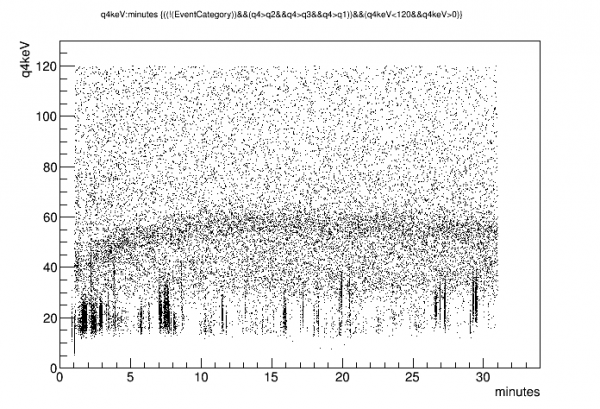 |
| At +11V from the DCRC we are finally able to see a 60keV line. |
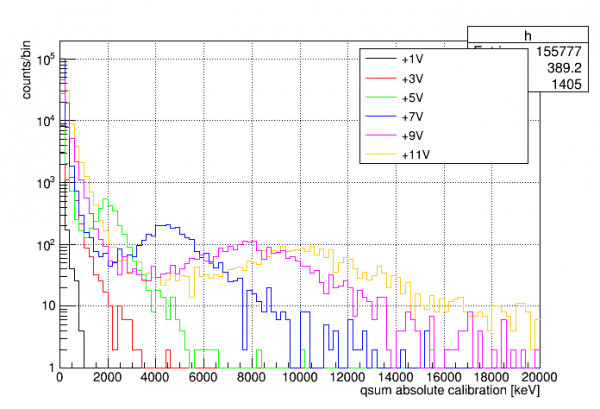 | 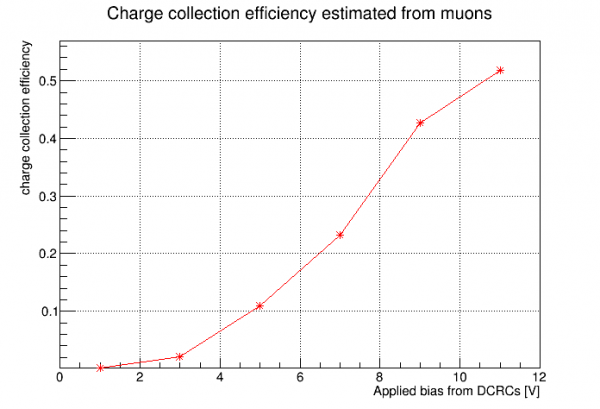 |
| The muon bulge keeps shifting to higher amplitude as we increase bias from +1V to +11V. This shows that we are still in a regime of low charge collection efficiency. | Estimated CCE seagull curve based on rough calibration to the muon bulge. From Run 67 it looks like the absolute calibration doesn't quite match the muon calibration, so I've based this on the Run 67 result, assuming that one to have been at 100% CCE. |