2020/10/10 (Saturday)
- Lab in-person: Michael
- Virtual partner: Matt, Ruiren
| Setup | Run 73. DIB 1/3/4 → Stripline 43/48/41 → pi-filters 1/2/3 → Cable 3/1/2 → nothing/nothing/accessory_interposer → HV_Conn 1/3/2 → HV 1/2 → DCRCX(4)/DCRC55(1)-master; DCRC33(2) → HV control. DCRCs off. Lead/poly shield erected (4 lead walls, 2 poly walls). |
|---|---|
| 8152 | MB = 71.9% |
| 0905 | Unrail some channels. Yesterday we selected 120 uA for DCRC4pB QET but that seems to low now, falls into s/c; set it to 150 uA now. |
| 0910 | Tower = 67.8 mK. A bit colder than yesterday. Unfortunately when the base is this high, pretty close to the Tc's, the QETs are pretty sensitive to temperature varations. May need to redo IbIs yet again. |
| 930 | Michael's body temperature = 98.2 F |
| 1000 | Michael arrives in lab |
| 1015 | Tower/MC/Coldplate = 67.6/31.4/193 mK, Still = 1.47 K / 0.130 mbar / 0 mW, G1/G2= 226/210 mbar, 1K Pot = 1.63 K / 22±2 mbar. |
| 1026 | Filled LN2 coldtrap bath |
| 1028 | Power cycled DCRC1 |
| 1031 | Zap DCRC1/4 squids |
| 1040 | Michael leaves lab |
| 1045 | Tower = 68.1 mK |
| 1115 | Seeing pulses in DCRC1pB - good! |
| 1400 | Do more IbIs for 67.5-67.8 mK, cuz this is where the temperature was settling. But then, very annoyingly, Tower rose to 68.4 mK. This level of variability at this temperature will make it difficult to take decent data. |
| 1430 | Select QET biases for dI/dP ~ 5 in all channels |
| 1438 | Start a 60 min series at HV = 0V, CDMS detector: Driver Gains = 1x, DCRC4/1 QET biases = (0,180,210,0)/(0,275,230,275)uA, Front-End Gains = (3/3/3)/(5/5/5) 1000 BOR & 5 Hz in-run randoms, trigger on DCRC1pD threshold = 8 Use sequence SimpleDataLoopNoFlash.msl |
| 1438 | Tower = 67.6 mK |
| 1538 | Tower = 67.3 mK. Dipped as low as 67.2 mK toward the end |
| 1557 | Start a 60 min series at HV = +100V, drifting 0.0274 V/s, prebias 15% for 2min, CDMS detector: Driver Gains = 1x, DCRC4/1 QET biases = (0,180,210,0)/(0,275,230,275)uA, Front-End Gains = (3/3/3)/(5/5/5) 1000 BOR & 5 Hz in-run randoms, trigger on DCRC1pD threshold = 8 Use RootSequencer.c, function drift_sequence(100,0.0274) |
| 1600 | Vtest = 1.5 mV shortly after drift begins. Drift appears to start at 105.9 V. 0.57% HV loss, very small |
| 1600 | Tower = 67.1 mK |
| 1658 | Tower = 66.6 mK. Temperature fell at steady rate. |
| 1658 | Drift ends, no apparent lag. Vtest = 2.4 mV. HV at end of drift looks like 203.9 V, indicating 0.47% HV loss |
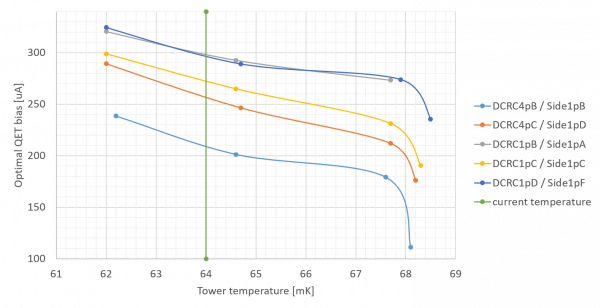
| 2030 | From the last four IbIs at different temperatures, I made an Excel plot for optimal QET bias as a function of temperature for each channel. Using that I reset the QET biases for the current temperature of Tower = 65.9 mK |
| 2107 | Start a 60 min series at HV = +300V, drifting 0.0262 V/s, prebias 15% for 2min, CDMS detector: Driver Gains = 1x, DCRC4/1 QET biases = (0,190,230,0)/(0,280,250,280)uA, Front-End Gains = (3/3/3)/(5/5/5) 1000 BOR & 5 Hz in-run randoms, trigger on DCRC1pD threshold = 8 Use RootSequencer.c, function drift_sequence(300,0.0262) |
|---|---|
| 2107 | Tower = 65.7 mK |
| 2107 | Vtest = 4.1 mV shortly after drift begins. Drift started at 313.4 V according to rootsequencer. 0.52% HV loss, very small |
| 2208 | Tower = 65.5 mK. Temperature fell at steady rate. |
| 2208 | Drift ends, no apparent lag. Vtest = 4.5 mV. HV at end of drift looks like 407.7 V, indicating 0.46% HV loss |
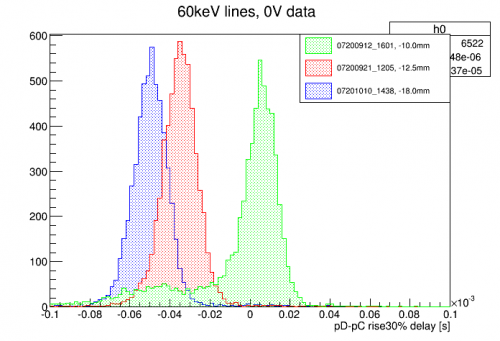 | 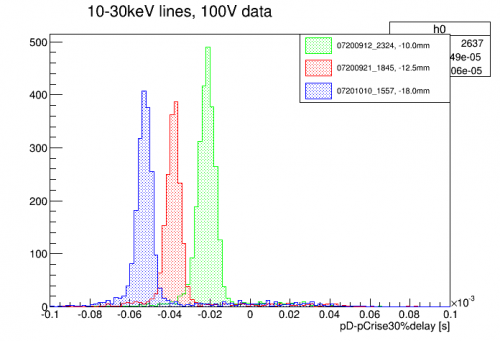 | 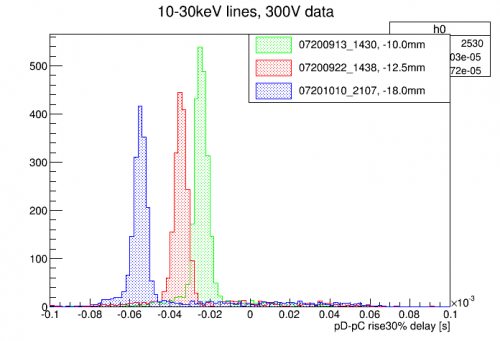 |
Observations about this new data with source at -18mm, which is close to the outer edge of pF:
- pF/pT is no longer as good for separating Am events, have started using (pF+pD)/pT
- pT resolution doesn't look nearly as good as before, much harder to see the low Am lines
- pA, as noticed a while ago, has surprisingly good resolution in terms of sharp Am lines