2020/09/10 (Thursday)
- Lab in-person: Zach
- Virtual partner: Matt
| Setup | Run 73. DIB 1/3/4 → Stripline 43/48/41 → pi-filters 1/2/3 → Cable 3/1/2 → nothing/nothing/accessory_interposer → HV_Conn 1/3/2 → HV 1/2 → DCRCX(4)/DCRC55(1)-master; DCRC33(2) → HV control. DCRCs on overnight. Lead/poly shield erected (4 lead walls, 2 poly walls). |
|---|---|
| 1101 | MB = 60.2% |
| 1115 | Zach body temp = 98.6 |
| 1120 | Zach arrives at lab. |
| 1128 | Tower/MC/Coldplate = 49.3/31.4/182 mK, Still = 1.29 K / 0.095 mbar / 0 mW, G1/G2= 253/291 mbar, 1K Pot = 1.69 K / 45±5 mbar. |
| 1132 | Swapped leads to HV for - bias. |
| 1143 | Filled LN2 cold trap dewar. |
| 1253 | Zach leaves lab. |
| 1800 | Zach body temp = 98.0 |
| 1646 | Start a 60 min series at HV = -100V, drifting 0.0271 V/s, prebias 15% for 2min, CDMS detector: Driver Gains = 1x, DCRC4/1 QET biases = (0,320,370,0)/(0,360,420,410)uA, Front-End Gains = (3/3/3)/(5/5/5) 1000 BOR & 5 Hz in-run randoms, trigger on DCRC1pD threshold = 8 Use RootSequencer.c, function drift_sequence(100,0.0271) |
|---|---|
| 1647 | Tower = 49.6 mK |
| 1647 | Vtest = -2.1 mV shortly after drift begins. Drift appears to start at -106.4 V. 0.79% HV loss. |
| 1715 | Looks like a glitch in the drift: HV jumps from -152.2 to -153.9 V in one step |
| 1717 | Another glitch, HV jumps down -156.3 to -154.8 V. That's like a correction of the last glitch, odd. |
| 1747 | Drift ends, no apparent lag. Vtest = -3.4 mV. HV at end of drift looks like -203.3 V, indicating 0.67% HV loss |
| 1747 | Tower = 49.6 mK |
| 1820 | Took a close look at Messages on the MIDAS page. This gives a record of the DCRC2qI setting and each time it was changed. You can see the operation of the Root sequencer - every 10 seconds there is a change. Plotting these values from 17:04 to 17:37, there is no indication at all of a glitch; changes come promptly every 10 sec (or close to it) and always essentially the same change, -0.0062 or -0.0063. So the glitch is either at DCRC2 (input or output) or HV power supply (input or output), or else it's the voltmeter or LabVIEW. Actually Vtest reacts during the glitches, and sometimes it looks like there is a temperature response, so it is real, not a meter or LabVIEW problem. |
| later look at data shows Lag Ratio = 0.996 |
| 2002 | Start a 60 min series at HV = -300V, drifting 0.0310 V/s, prebias 15% for 2min, CDMS detector: Driver Gains = 1x, DCRC4/1 QET biases = (0,320,370,0)/(0,360,420,410)uA, Front-End Gains = (3/3/3)/(5/5/5) 1000 BOR & 5 Hz in-run randoms, trigger on DCRC1pD threshold = 8 Use RootSequencer.c, function drift_sequence(300,0.031) |
|---|---|
| 2002 | Tower = 49.7 mK |
| 2002 | Vtest = -5.8 mV shortly after drift begins. Drift appears to start at -315.8 V. 0.73% HV loss. |
| 2021 | Looks like a glitch in the drift, seen as a low outlier in Vtest. |
| 2023 | Another glitch, low Vtest outlier |
| 2032 | Another glitch, low Vtest outlier |
| 2103 | Drift ends, no apparent lag. Vtest = -7.8 mV. HV at end of drift should be -427.4 V, indicating 0.73% HV loss |
| 2103 | Tower = 49.6 mK |
| later look at data shows Lag Ratio = 0.996 |
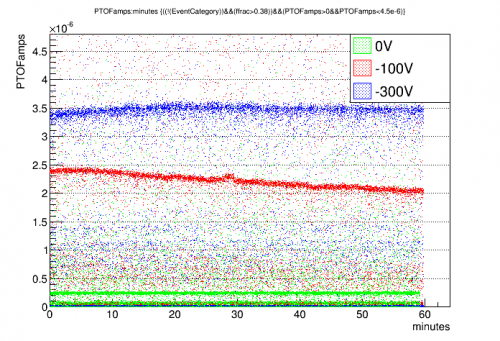 |
| -100V drift was too slow. -300V drift a little too fast. |
| Let's try moving the source over the blocker | |
| 2215 | Arduino Editor is still connected to the Arduino. Do rd dwell, verify that it's still 40 ms |
| 2220 | Move source -4×29 steps with 4 minute pause after each move, mvNwait -4 240 29 |
| This should move the source to y = -5.887 mm (not corrected for thermal contraction). That's in the middle of the blocker. Total sequence should take 1hr 56min, ending at 24:16. | |
| first move spikes temperature to about 0.95 K. Later peaks were around 1.1K, minima around 0.8K. |