2020/09/04 (Friday)
- Lab in-person: Zach
- Virtual partner: Matt
| Setup | Run 73. DIB 1/3/4 → Stripline 43/48/41 → pi-filters 1/2/3 → Cable 3/1/2 → nothing/nothing/accessory_interposer → HV_Conn 1/3/2 → HV 1/2 → DCRCX(4)/DCRC55(1)-master; DCRC33(2) → HV control. DCRCs on overnight. Lead/poly shield erected (4 lead walls, 2 poly walls). |
|---|---|
| 0830 | MB = 68.9% |
| 0920 | Write a sequence for -250V constant bias. 15% 2-minute prebias. 60 minutes at -250V, then rampdown to 0V, then 30 minutes more data. Then flash. HV_neg250V_pre15-2min_60min_0V_30min.msl |
| 0937 | Start a 60/30 min series at HV = -250V/0V, no drift, prebias 15% for 2min, CDMS detector: Driver Gains = 1x, DCRC4/1 QET biases = (0,320,370,0)/(0,360,420,410)uA, Front-End Gains = (3/3/3)/(5/5/5) 1000 BOR & 5 Hz in-run randoms, trigger on DCRC1pD threshold = 8 Use sequence HV_neg250V_pre15-2min_60min_0V_30min.msl |
| 0938 | Tower = 50.5 mK |
| 0938 | Vtest = -9.4 mV shortly after prebias and rampdown. HV = -254.0 V. 1.5% HV loss. |
| 1000 | Vtest has relaxed to -9.0 mV, HV = -253.9 V. 1.4% HV loss. |
| 1038 | Constant HV period ends. Vtest = -8.7 mV, 1.4% HV loss. |
| 1038 | Tower = 50.8 mK |
| 1046 | HV finishes rampdown to 0V. Tower = 50.7 mK |
| 1116 | Series ends. Tower = 50.4 mK |
| Tower temperature pattern seems like it may be affected by the biasing. During the rampup and prebias and for the first ~30 minutes at constant bias, Tower temperature was fairly flat at 50.5 mK. Then it rose quickly to 50.7 mK and continued rising during the constant bias period to 50.9 mK. The peak occurred right around when the constant bias ended, and the Tower temperature started to fall when the rampdown began, falling back to 50.4 mK over 30 minutes. This brings to mind what we have been observing with high -bias: after around 20-25 minutes, it looks like the charge leakage suddenly increases, as seen both in the gain-versus-time plots and in wider noise seen after this time. So, it looks like the increased charge leakage has a small but measurable effect on base temperature. On the other hand: in this case the detector bias is continuously decreasing, so you expect the charge leakage to be steadily falling. |
| 1300 | Zach body temp = 98.9 |
|---|---|
| 1315 | Zach arrives at lab. |
| 1317 | Tower/MC/Coldplate = 50.9/31.9/196 mK, Still = 1.52 K / 0.095 mbar / 0 mW, G1/G2= 254/278 mbar, 1K Pot = 1.70 K / 50±2 mbar. |
| 1230 | MB = 62.5% |
| 1320 | Switched HV leads to + bias |
| 1401 | Filled LN2 cold trap dewar. |
| 1402 | Zach leaves lab. |
| 1630 | Zach body temp = 98.7 |
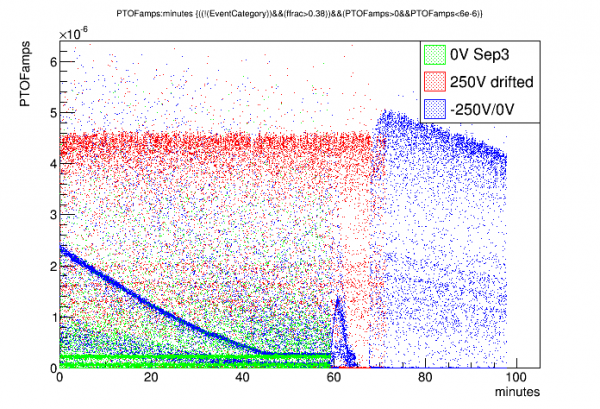 |
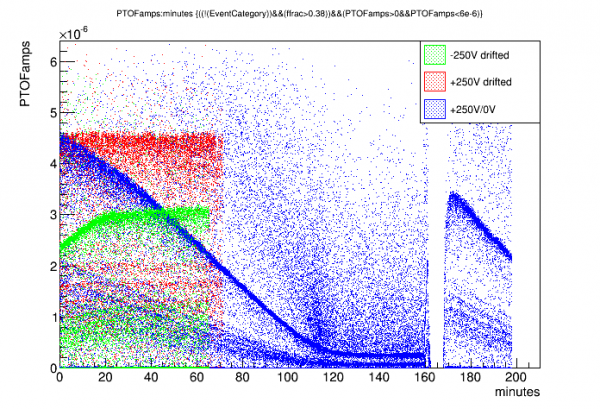
| Gain falls from its initial value to the 0V value. Then from 60-68 minutes the rampdown occurs - not sure exactly what we are seeing there. Then the gain rises to a value similar to +250V and starts to fall. Apparently the self-biasing is equivalent to +250V. |
| 2050 | Edit the sequence from earlier for +250V constant bias to stay at bias longer, because it will take a lot longer to fall to 0V. Change from 3600 seconds to 9600 seconds, i.e. 2 hr 40 min. |
|---|---|
| 2111 | Start a 160/30 min series at HV = +250V/0V, no drift, prebias 15% for 2min, CDMS detector: Driver Gains = 1x, DCRC4/1 QET biases = (0,320,370,0)/(0,360,420,410)uA, Front-End Gains = (3/3/3)/(5/5/5) 1000 BOR & 5 Hz in-run randoms, trigger on DCRC1pD threshold = 8 Use sequence HV_neg250V_pre15-2min_60min_0V_30min.msl |
| 2111 | Tower = 50.6 mK |
| 2111 | Vtest = 9.0 mV shortly after prebias and rampdown. HV = 252.8 V. 1.4% HV loss. |
| 2220 | Vtest has relaxed to 8.5 mV, HV = 253.9 V. 1.3% HV loss. |
| 2310 | Vtest has relaxed to 7.3 mV, HV = 253.9 V. 1.2% HV loss. Tower = 50.6 mK, pretty flat. |
| 2351 | Constant HV period ends. Vtest = 6.6 mV, 1.0% HV loss. |
| 2351 | Tower = 50.6 mK |
| 2400 | HV finishes rampdown to 0V. Tower = 50.5 mK |
| 2430 | Series ends. Tower = 50.4 mK |