2019/03/14 (Thursday)
| Setup | DIB1/3/4 → 3.2 MHz filters 2/3/1 → cable 3/1/2 → gender changer 3/?/2 → HVConn 1/3/2 → HV 1/2 → DCRCX(4)/DCRC50(3) manual kepco 1kV power supply → HV input |
|---|---|
| 0900 | Tower/MC/Coldplate = 49.7/31.6/199 mK, Still = 1.75±0.05 K / 0.160 mbar, G1/G2 = 203/217 mbar, 1K Pot = 1.78 K / 17 mbar. MB = 30.8% |
| Tower cooling at a rate of 1.78 mK/day Overnight it spiked, then fell, then rose to a plateau for a while, then fell again (excursions only a few 10ths of a mK). Maybe this was a channel going into a bad state and coming back out. |
|
| 0920 | Fill LN2 cold trap bath |
| 1108 | Tower temp starts climbing. |
| 1147 | Tower = 50.8 mK. Probably have a ringing channel. DCRC3 PC,PD have no pulses, appear to be SC. Pulses with minor ringing on all other channels. Try setting DCRC3 PB QET bias to 0. Tower temp starts falling immediately. |
| 1155 | After a few minutes, tower temp starts rising again. Set DRCR3 PC QET bias = 0 also. Temp still rising. Start setting the other channels to QET bias = 0 also. |
| 1200 | With all channels SC, tower temp starts falling. |
| 1210 | Tower temp falling, but oscillating by ~0.1 mK as it goes. Put all channels at QET bias = 500 uA. |
| 1215 | Tower = 49.1 mK. Pulses seen on all channels. |
| 1240 | Tower temperature falling, now 48.5 mK |
| 1240 | Finish rebuilding lead stack for the PuBe shield. Used the following design: 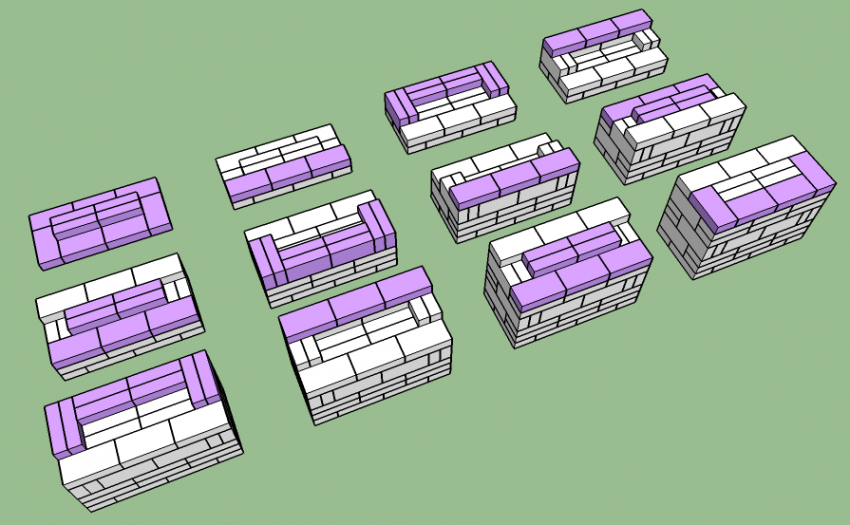 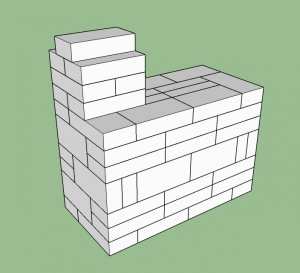 |
| 1335 | Begin LHe transfer, MB = 23.8% |
| 1410 | Cease LHe transfer, MB = 92.5% |
| 1435 | Tower rose to 48.9 mK beginning and end of transfer, but currently at 48.1 mK and falling. |
| 1500 | Get channels back into transition with QET biases = (415/370/420)/(400/370/420) uA, Front-End Gains = (4/2/3)/(10/15/10) Some channels set a little higher than yesterday due to lower tower temp. |
| Let's try to push to even higher HV today. The E-box vacuum feedthrough is rated for 500 V. Let's stay below 400 V to be on the safe side. | |
| 1550 | Watching DCRC4pA, start increasing the bias. We turned the big knob one click at a time, but on the second click the noise and baseline increased dramatically. After the second click we used the small knob to increase gradually. Then for the next click we first dialed down the small knob before clicking up the big knob. At the end we backed down from 400V back to 300V to see whether “prebiasing” helps (no clear evidence that it does). |
| Dial | HV [V] | Vtest [mV] | Velectrode [V] | Baseline [V] | Noise @ 1kHz | signal/noise |
|---|---|---|---|---|---|---|
| 0 | 0 | 0 | 0 | 2.00E-06 | 0.5 | |
| CLICK | 86 | 22 | 77.2 | 0.03 | 4.00E-06 | 6.7 |
| CLICK | 195 | 170 | 127 | 0.5 | ||
| wait | 195 | 32 | 182.2 | 0.1 | 7.90E-06 | 7.8 |
| wait | 195 | 26 | 184.6 | 0.03 | 4.00E-06 | 15.6 |
| Gradual | 250 | 64 | 224.4 | 0.21 | 7.90E-06 | 9.6 |
| wait | 250 | 38 | 234.8 | 0.07 | 4.40E-06 | 18 |
| Gradual | 295 | 81 | 262.6 | 0.3 | 1.00E-05 | 8.9 |
| wait | 295 | 46 | 276.6 | 0.08 | 1.00E-05 | 9.3 |
| wait | 295 | 42 | 278.2 | 0.05 | 6.30E-06 | 14.9 |
| Gradual | 332 | 60 | 308 | 0.1 | 8.70E-06 | 11.9 |
| wait | 332 | 50.4 | 311.8 | 0.04 | 3.20E-06 | 32.8 |
| Gradual+CLICK | 330 | 53 | 308.8 | 0.03 | 3.20E-06 | 32.5 |
| Gradual | 350 | 70 | 322 | 0.1 | 5.00E-06 | 21.7 |
| wait | 350 | 53 | 328.8 | 0.03 | 4.00E-06 | 27.7 |
| Gradual | 400 | 88 | 364.8 | 0.25 | 1.00E-05 | 12.3 |
| wait | 400 | 67 | 373.2 | 0.07 | 7.90E-06 | 15.9 |
| wait | 400 | 64.7 | 374.1 | 0.04 | 4.00E-06 | 31.4 |
| Gradual | 350 | 20 | 342 | 0.025 | 3.20E-06 | 35.9 |
| wait | 350 | 50.7 | 329.7 | 0.015 | 3.20E-06 | 34.7 |
| 1640 | Finish above HV test, dial down to 0V. Note that in the time that it took to do this measurement, the counter bias in the detector rose to about 200V. So difficult to interpret the above too literally. The main result is that we can go to HV = 400V with nothing obviously bad happening. |
|---|---|
| 1705 | Fill LN2 cold trap bath |
| 1712 | Tower = 47.8 mK. MB = 90.9% |