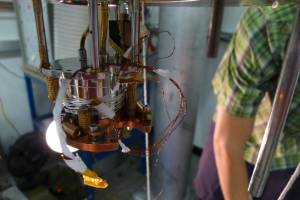
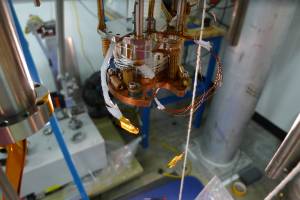
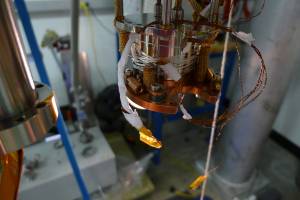
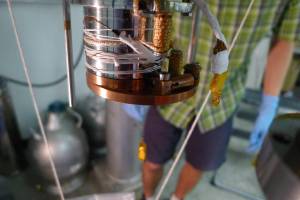
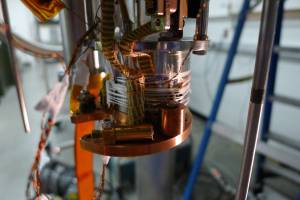
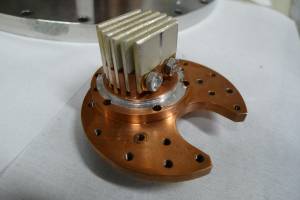
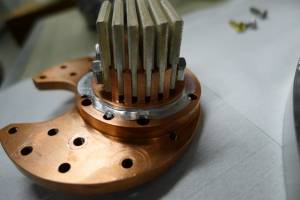
| | Status: fridge at room temperature, cryostat Dewar is down, IVC is entirely removed. Pumping on still with leak detector, attached at top of fridge.
Mixture is in dump and 3He pump, manual dump valves are closed. |
| | Yesterday a slight room temperature leak from IVC to fridge lines could be produced by bagging the IVC and filling with helium, but the signal could not be brought down again by flushing with nitrogen. Results inconclusive. |
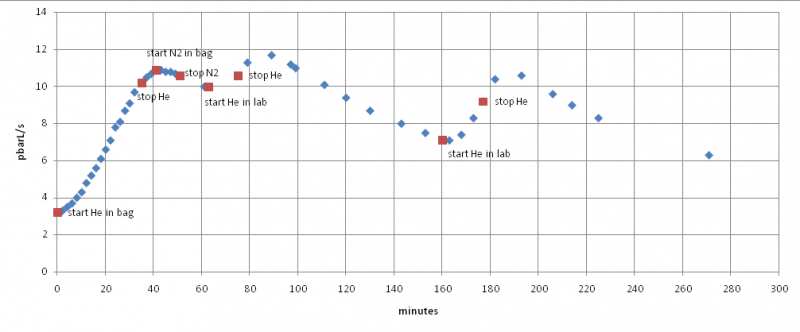
| 0815 | Leak = 3.1 pbarL/s |
| 0820 | Squirting helium at various parts of the fridge plumbing produces no significant increase in leak signal |
| 0835 | Form a bag around the dilution unit using plastic sheeting and packing tape. Form cylinder and tape to IVC top flange, then tape over screw holes at top. Tape along the seam. At bottom pull into a cone with a small opening at the bottom. |
| 0840 | Begin feeding helium into IVC through top port. (Not using turbo pump manifold, instead attached hose barb to end of metal hose leading to top port.) Can feel air coming out of bottom of bag. |
| 0900 | Over the first 20 minutes the leak signal has increased from 3.2 to 6.6 pbarL/s and continues to increase about 0.25 pbarL/s per minute. Note that helium is flowing faster than yesterday because it's not going through the needle valve at the turbo station. |
| 0910 | Leak has risen to 9.1 pbarL/s after 30 minutes of flowing helium into bag. Still increasing at about 0.2 pbarL/s per minute |
| 0915 | Stop flowing helium into top port of IVC. Signal continues to increase but more slowly, about 0.1 pbarL/s per minute |
| 0920 | Begin flowing nitrogen into bag from the bottom, leaving top port open. Signal stops increasing, steady at 10.8 pbarL/s |
| 0935 | Stop flowing nitrogen. Leak has fallen slightly, to 10.6 pbarL/s. |
| 0945 | Leak signal has fallen to 10.0 pbarL/s.
Start flowing helium out of hose near bottom of bag, but not into bag. This is to see whether just blowing helium into the room increases the leak signal. Over 10 minutes, leak signal increases from 9.7 to 10.6 pbarL/s. So, maybe it's just helium in the room. |
| 0955 | Stop helium flow. Over 15 minutes leak signal continued to increase, from 10.6 to 11.7 pbarL/s. Then over the next 10 minutes it fell from 11.7 to 11.0 pbarL/s. |
| 1055 | Leak signal has been decreasing slowly, -0.07 pbarL/s per minute. Currently 8.6 pbarL/s. |
| 1115 | Leak signal is 7.5 pbarL/s. With still gate valve closed, leak signal falls to 5.3 pbarL/s. |
| 1122 | Begin flowing helium into room again. Over 15 minutes leak signal begins to increase about as fast as the first test this morning when filling the bag with helium. |
| 1135 | Leak signal 8.3 pbarL/s, 6.4 pbarL/s with gate valve closed. So the increase in rate in the leak detector tubing seems to be as high as the overall increase. |
| 1140 | Stop flowing helium. Signal increases for 5 minutes then seems to level off. Gate-valve-closed signal continues to track with gate-valve-open signal, with gate-valved-closed always close to 2.0 pbarL/s smaller. |