2016/07/18 (Monday)
| Setup: iZIP mode, DIB1/2/3 → cables → 3.2 MHz filters → DCRC55(1)/33(2)/50(3) | |
| Took bg data yesterday, DCRCs on overnight. Note: fridge was cooled below Al transition with mu-metal shield lowered 23.2 cm | |
| 0835 | Tower/MC/Coldplate = 36/41/145 mK, Still = 1.67 K / 0.100 mbar, G1/G2 = 180/160 mbar, 1K Pot = 1.48 K / 4.0 mbar. MB = 57.4% |
| MC(H35) thermometer is unstable, minimum 37 mK but random spikes as high as 65 mK every few minutes. But Tower and Coldplate temperatures look OK. |
Boiloff: the boiloff rate is high, as it was when we had the Taconis oscillation problem. I haven't looked at data yet but likely the oscillations are appearing in data too, as they were before. For a while we were eliminating this problem by letting pressure out of the MB five minutes after a fill. We are continuing to do that, but now that the recovery system one-way valve has been installed correctly, it doesn't seem to be working. Previously we were letting pressure out of the entire recovery system, to a low enough level that the bath never developed Taconis oscillations. Now however we are only letting pressure out of the main bath. My guess is that the pressure in the bath builds up quickly after that, and since the recovery system pressure is still high the one-way valve does not allow this pressure to release into recovery. It will not release until the bath pressure builds to as high as the recovery system pressure. The pressure builds high enough to allow Taconis oscillations to develop.
What can we do? Probably we will need to release pressure multiple times after a fill, for now. To keep oscillations low (so that we can take good data and so that the bath hold time is long) it may be necessary to leave the bath open to air for an hour or more after a fill. We will need to experiment.
| 0855 | Fill LN2 cold trap bath. |
|---|---|
| 0935 | It's still the case that MC(H35) is unstable but Tower is stable. Tower = 36 mK, MC = 38-60 mK. |
| 1030 | Commence LHe transfer (52.8%) |
| 1105 | Fill HPGe crystal dewar with LN2. |
| 1110 | End LHe transfer (93.5%). |
| 1130 | Get all phonon channels showing pulses. Jagged noise present on several channels. Not tachonis (not a sine wave). See below for example: |
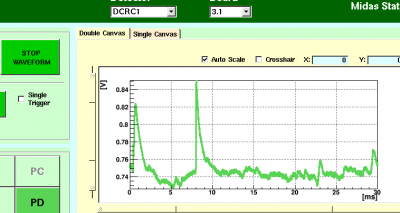 |
| 1140 | Release pressure from Main Bath to see if noise is affected. It is not. Though it is noticed that during the release of pressure, it appears that our He recovery meter still runs backwards slightly. Much less than previously. |
|---|---|
| 1150 | Zap SQUIDs to attempt to get rid of the noise. |
| 1215 | Since ending the transfer I've put my ear on the fridge rack to listen for Taconis, haven't noticed any. Release pressure from bath again. Recovery meter runs backward again for suspiciously long, are we still letting pressure out of the recovery system? Should be blocked by one-way valve. |
| 1220 | Noise may be gone, but now the pulses are also gone on some channels (DIB3 pA). We just have 10mVpp white noise on those channels. Adjusting the QET bias seems to fix the issue, though that raises the question of why a few mK in temperature increase would necessitate a 40uA lowering of QET bias. |
| 1300 | After fighting the crashing GUI and various bugs, all the channels are (noisy but) showing pulses. Start a 30min background series at -4/+4 V with FG=5/2/5, OG=8/3/8, with 1000 initial randoms, 1000 ending randoms, with 30s flash and 25 minute cooldown between series. Trigger on DIB1 phA with threshold of 30ADC bins, with 150 us pileup cut window. |
| 1400 | Looking at raw data from this run shows that the timing link seems not to be working. Pulses are seen in the correct place in DIB1 but DIB2&3 show no pulses or pulses in the wrong place, i.e. the DIB2&3 traces must not be synced to the DIB1 traces. |
| 1409 | Closed the telnet session to DCRC4. That shouldn't make any difference, but worth a try. Start a brief run without flashing, 0 bias, labeled “test”, to see whether it looks like the pulses are synced. |
| 1420 | Manually establish timing link after ensuring the timing link cables are firmly plugged in to the DCRCs. |
| The test data looks good (properly aligned across the DIBs). | |
| 1430 | Start a 30min background series at -4/+4 V with FG=5/2/5, OG=8/3/8, with 1000 initial randoms, 1000 ending randoms, with 30s flash and 25 minute cooldown between series. Trigger on DIB1 phA with threshold of 30ADC bins, with 150 us pileup cut window. |
| 1530 | Commence procedure to warm up to above 1.7K. The procedure is outlined in the following link: |
| 1542 | After turning on the MC Heater to 1mW, Tower Temp: 345mK and rising. G1/G2: 97/98 mbar. P1: 10mbar and rising. |
|---|---|
| 1550 | P1: 50mbar, open V3 to equalize pressures. Tower Temp: 600mK and rising. G1/G2: 16/98 mbar. |
| 1605 | Tower temperature reaches ~2K. Recommence circulation and turn off MC Heater. |
| 1620 | Tower temperature: 1.63K and dropping. 1K Pot has almost run dry (P2: 3.4mbar). Open 1K Pot needle valve by 1/16th of a turn. |
| 1830 | G1 and G2 have stayed steadily ~400 mbar (peaking just around 500 mbar), and tower temperature maintains ~1.6K temperature after about two hours of fruitlessly waiting for circulation to begin using the previously described method. Close V6, open V9 to let some mixture into the dump and allow pressures on G1/G2 to drop from the ~400mbar range. This happened very quickly since the dump was empty before this. Then begin condensation procedure as described in the run manual. Pressures stay below 200mbar, and since some of the mixture is already condensed inside the fridge, pressures only rise to ~150mbar. Close V9 when G2 reads 90mbar, and open V6 to 13% before seeing any increase in G2. |
| Keep opening V6 to 13.7% before G1/G2 begin rising appreciably. Leave it for a minute, and then P1 begins to drop from 1000mbar. And so, circulation has finally commenced. Keep opening V6 until it's all the way open. Tower temperature 1.3K and dropping. | |
| 1835 | Fill LN2 cold trap full. |
| 1841 | Leaving with G1/G2 = 288/262 mbar, tower =340mK and dropping. Some mixture left in the dump must be pulled out tomorrow. |