2015/07/10 (Friday)
| overnight status: baking detector, no Cf source on fridge (skip a day of activation), DIB1/2/3 → no filter/100 MHz C filter/no filter → DCRC55/33/50, but only DCRC33 powered | |
| 0843 | Tower = 30.6+/-0.4 mK, Still = 0 mW / 0.11 mbar, G1/G2 = 190/180 mbar, 1K Pot = 1.68 K / 13 mbar, Main bath = 58.2% |
| 0850 | Fill LN2 cold trap Dewar |
| 0900 | Pulses still look good in DIB2 with no other DCRC powered. |
| 0954 | Take a data run with only DCRC33/DIB2. float/0 V. |
| 1046 | Watch DIB2 while activating DIB1→DCRC55. Plug in DCRC55: pC&pD rail, pA&pB show new noise @ 0.8kHz/2kHz. Relock pC&pD, also show noise. |
| 1051 | issue startup commands to DCRC55. Plug timing cable in: noise in DIB2 channels gets worse. |
| 1054 | set up timing link. when slave set to wr 15 10, noise in DIB2 changes to 250Hz sinusoid. |
| 1103 | 250Hz noise has gone away over time. Now a cuspy 200Hz waveform in DIB2pD. Otherwise pulses look OK. |
| 1121 | Zap DIB1 SQUIDs, apply SQUID/QET settings to DIB1. (Pulses rather ugly.) |
| 1122 | Now that DIB1 phonons set, DIB2 pulses look ugly, particularly pA and pC. |
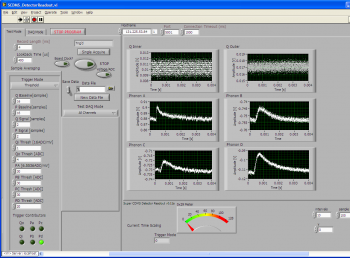
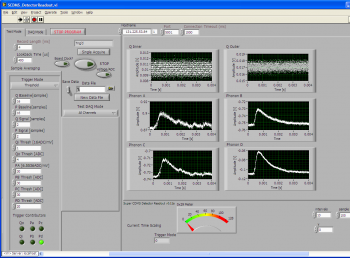
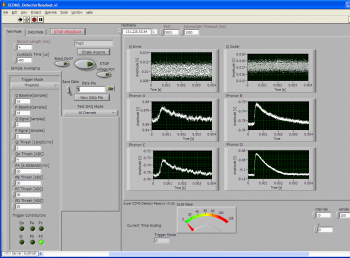
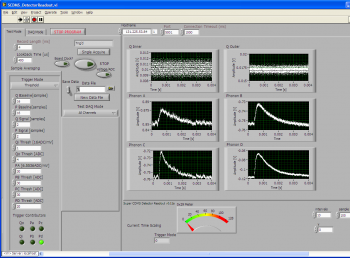
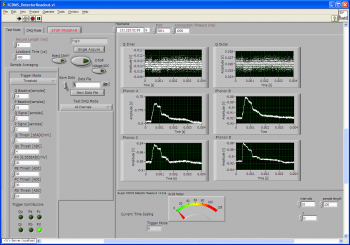
| 1124 | Experiment with turning DIB1 phonon settings off and on to see the effect on DIB2 pulse shapes. Note that in the plots below I focus on events in which the phonon pulse heights are around 40 mV. |
| DIB2→100MHz→DCRC33 phonons with DIB1 phonon channels off - no SQUID or QET bias, grounded SQUID output | |
|---|---|
 |  |
| DIB2→100MHz→DCRC33 phonons with DIB1 phonon SQUIDs on but QET bias=0 | |
|---|---|
 |  |
| DIB2→100MHz→DCRC33 phonons with DIB1 phonon channels on, set normally | |
|---|---|
 |  |
Conclusion: having the QET biases on on DIB1 degrades the pulse shapes on DIB2.
| 1210 | Set DIB2 thresholds to 40/20/25/20 |
|---|---|
| 1212 | Start data run, DIB2 only, with no SQUID or QET biases on DIB1. 0/0 V. |
| 1223 | Start data run, DIB2 only, with standard DIB1 phonon settings. 0/0 V. |
| 1233 | Start data run, DIB2 only, with DIB1 SQUIDs biased but QETS at 0 bias, 0/0 V. |
| note | Event rates as high as 25 Hz seen when running bkg data with only one DCRC. Highest we usually see in 3-DCRC running is around 18 Hz. |
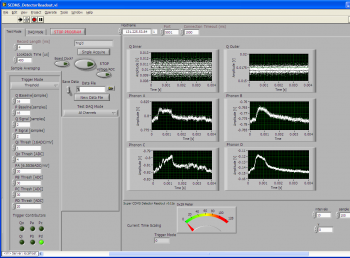
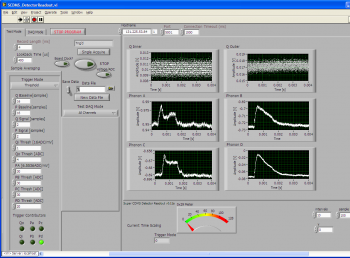
| 1250 | Restore standard phonon settings on DIB1 and look at DIB1 pulses with DIB2 phonons in various conditions: |
| DIB1→DCRC55 phonons | ||
|---|---|---|
| with DIB2 p-channels ON | with DIB2 p-channels OFF | with DIB2 turned off |
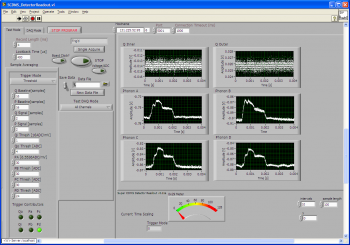 | 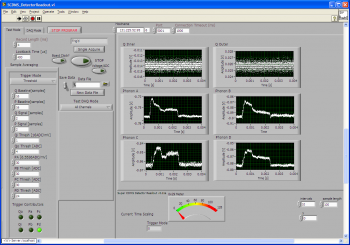 |  |
Conclusion: DIB1→DCRC55 pulses are ugly regardless of DIB1 phonon settings.
| 1330 | Swap DIB1&2 DCRCs, also remove filter. Now DIB1/2 → no filters → DCRC33/55. Zap SQUIDs and find SQUID settings for DIB1, also approximate QET biases: |
|---|
| DIB1 DCRC33 SQUID and QET Settings | |||
|---|---|---|---|
| Channel | Bias (mA) | Lockpoint (mV) | QET bias (μA) |
| A | 80.08 | 6.42 | -100 |
| B | 83.99 | 5.16 | -105 |
| C | 82.04 | 3.60 | -112 |
| D | 82.04 | 3.41 | -93 |
| 1331 | Also all FrontEnd/Output gains were set to 7/1. |
|---|---|
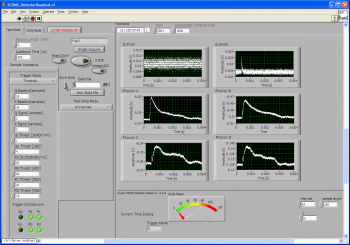
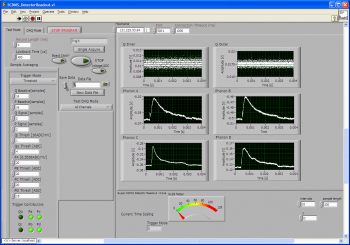
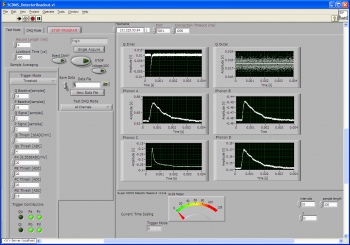
| 1408 | DIB1 pulses don't look very good, even with DCRC33. We tried again with the 100 MHz filter in place, and the pulses looked better. We removed it and replaced it again, and the effect was repeatable - see pictures below. Note that with the filter in place, the FrontEnd Gain on pD had to be reduced from 7 to 6 to avoid a rather high amplitude, high frequency noise in all channels. |
| DIB1→no filter→DCRC33 phonons with DIB2 off | |
|---|---|
 |  |
 | 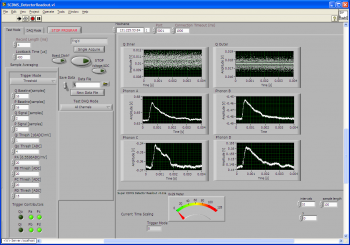 |
| DIB1→100 MHz filter→DCRC33 phonons with DIB2 off | |
|---|---|
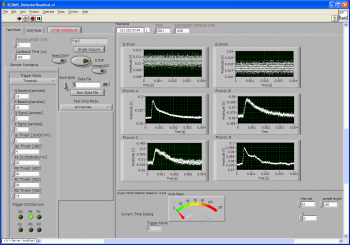 | 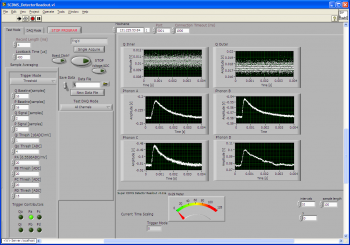 |
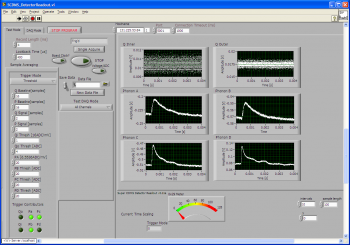 | 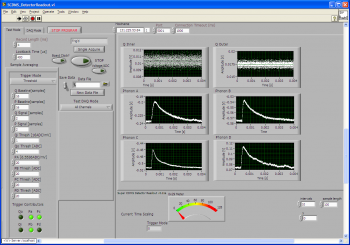 |
Conclusion: The 100 MHz filter seems to improve DIB1→DCRC33 pulses. (although pD still looks mediocre, and has some baseline noise. Note this is the channel that showed a bad connection at the beginning of the run, then miraculously became operational.)
| 1633 | Power up DIB2→DCRC55. Zap SQUIDs. Find SQUID settings and approximate QET biases: |
|---|
| DIB2 DCRC55 SQUID and QET Settings | |||
|---|---|---|---|
| Channel | Bias (mA) | Lockpoint (mV) | QET bias (μA) |
| A | -76.17 | -2.04 | 100 |
| B | -68.36 | -1.46 | 105 |
| C | -80.08 | -3.21 | 115 |
| D | -76.17 | -2.14 | 110 |
| 1722 | First look: DIB2→DCRC55 pulses have some ugly shapes, at least with DIB1 phonons on. DIB1→DCRC33 pulses look worse now that DIB2 is on. |
|---|---|
| 1731 | DIB1 pulses look OK when DIB2 QET biases off. Any DIB2 QET bias turned on degrades the DIB1 pulse shapes, but the effect is most dramatic with DIB1pD. Specifically, turning on DIB2pA,B,C produces definite “shelving” on the DIB1 pulses - then turning on DIB2pD makes the shelf-like drop-off occur earlier. |
| note also that FrontEnd gains on DIB2 were at 1 throughout these tests. Output Gains were at 1 originally but at 0 the effect is about the same. Gain settings don't seem to be a factor in how one DIB's pulses degrade another DIB's pulses. |
Basic observations: DCRC55 board still hasn't produced good pulses (on two different DIBs). DCRC33 board with filter can produce OK pulse shapes on different DIBs. Biasing QETs on the RevC.1 DIB degrades pulse shapes on RevC DIB, and the effect is repeatable when the boards are swapped on the two DIBs.
| 1745 | Fill LN2 cold trap full. |
|---|