2014/03/28
| 1010 | Fill LN2 cold trap full. |
|---|---|
| 1045 | Commence LHe transfer (10.2%) |
| 1135 | End LHe transfer (91%) |
| 1425 | Relock SQUIDs and continue troubleshooting DCRC50 with DCRC50 connected to DIB1 (stripline 27) and DCRC31 connected to DIB2 (stripline 19). SQUID bias and Lockpoints listed below: |
| Phonon Channel | SQUID Bias [uA] | Lock Point [mV] | Modulation [Vpp] |
|---|---|---|---|
| DIB 1 Ch A | -80.08 | -3.99 | .320 |
| DIB 1 Ch B | -82.03 | -2.43 | .339 |
| DIB 1 Ch C | -85.94 | -2.43 | .376 |
| DIB 1 Ch D | -80.08 | -2.33 | .317 |
| DIB 2 Ch A | 85.94 | 5.06 | .430 |
| DIB 2 Ch B | 70.32 | 2.63 | .341 |
| DIB 2 Ch C | 76.18 | 4.18 | .543 |
| DIB 2 Ch D | 82.04 | 2.82 | .414 |
| 1540 |
|---|
Data Analysis: Detector Neutralization
This data analysis uses the following data
07140328_0429
07140328_0519
07140328_0610
07140328_0700
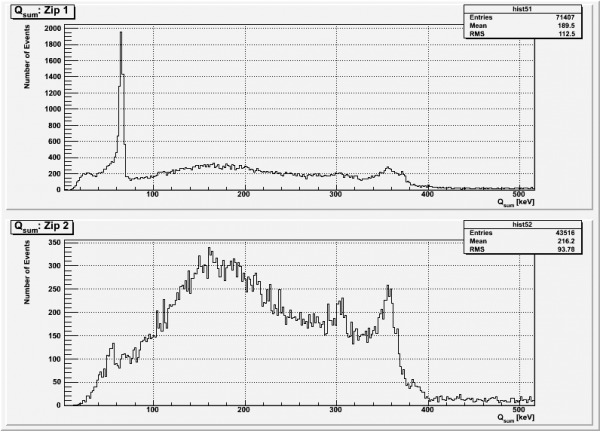
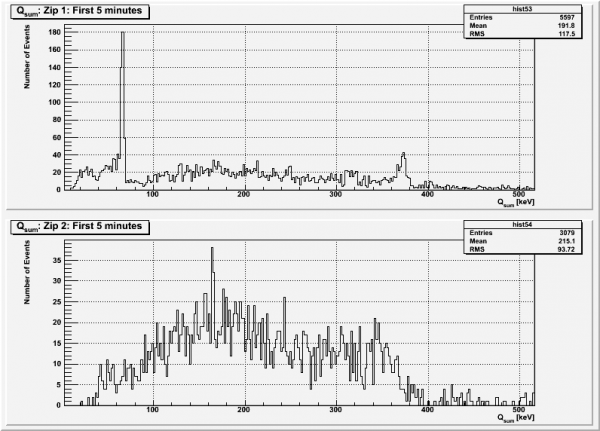
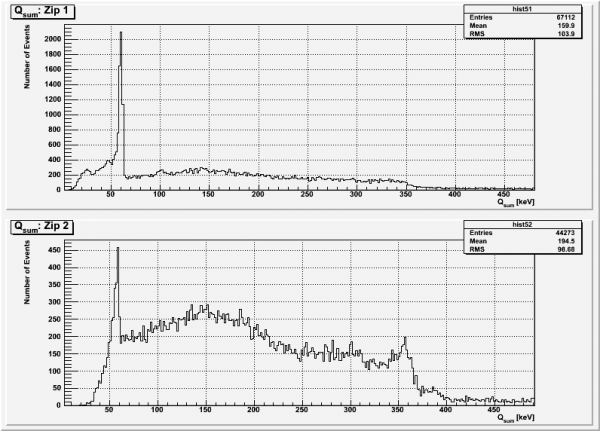
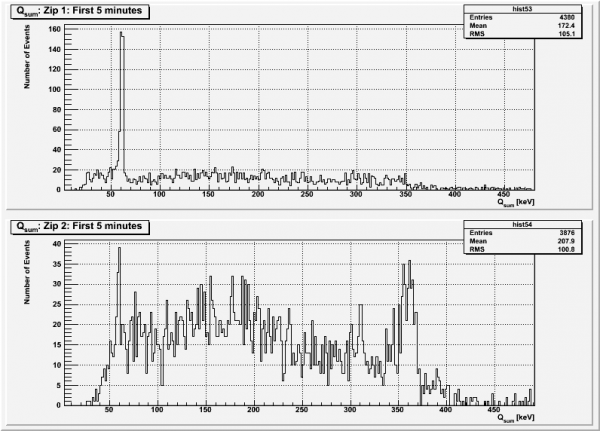
where the first two series have a +/-4V voltage bias applied and the second two series have a -/+4V voltage bias applied. A Ba-133 source was placed outside of the fridge dewar and Pb-210 and Am-241 sources were places in the tower. The 60 keV peak from the Am-241 source, as well as the 356 keV peak from the Ba-133 source can be clearly seen in the charge spectra below. Charge calibration was performed via the 356 keV peak when possible, and the 60 keV peak when necessary.
-/+ 4 V
| Figure 1: -/+4 V Qsum spectra, Qinner, Chisq Cuts |
|---|
 |
| Figure 2: -/+4 V Qsum spectra, Qinner, Chisq, and <5min Cuts |
|---|
 |
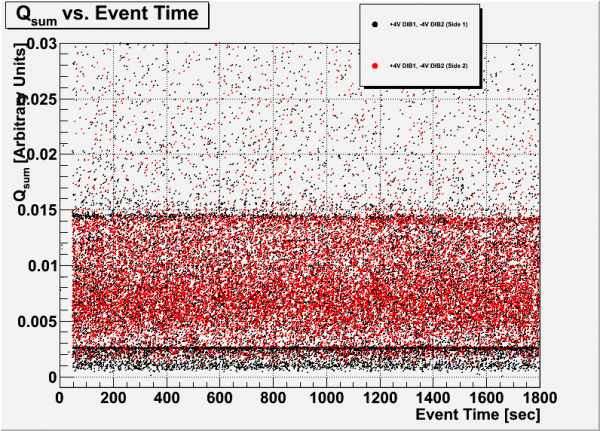
| Figure 3: -/+4 V Qsum vs Event Time |
|---|
 |
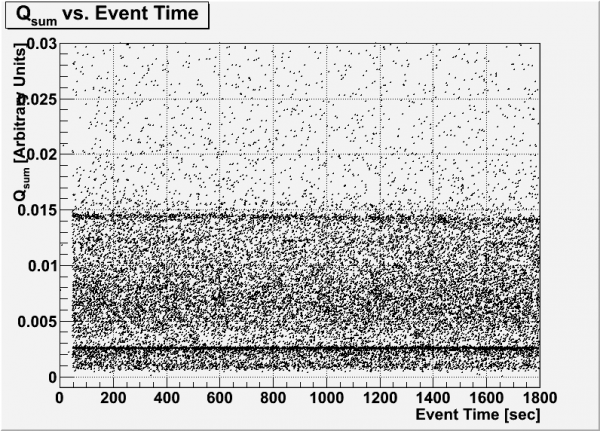
| Figure 4: -/+4 V Qsum vs Event Time: Side 1 |
|---|
 |
| Figure 5: -/+4 V Qsum vs Event Time: Side 2 |
|---|
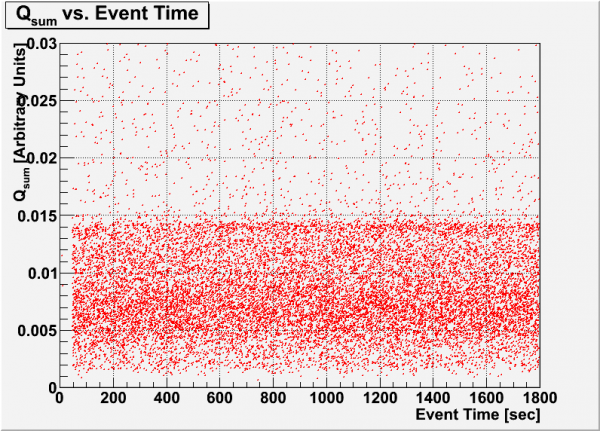 |
It is difficult to see when charge neutralization is lost in the above figures. It seems as though the charge neutralization is good up until 1000 seconds in, but this is not clear enough to be decisive.
-/+ 4 V
| Figure 6: +/-4 V Qsum spectra, Qinner, Chisq Cuts |
|---|
 |
| Figure 7: +/-4 V Qsum spectra, Qinner, Chisq, and <5min Cuts |
|---|
 |
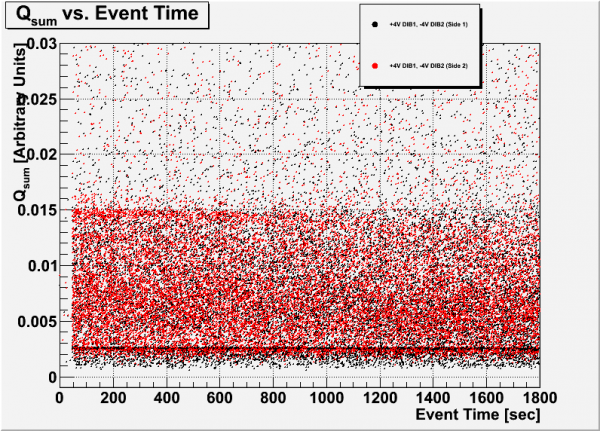
| Figure 8: +/-4 V Qsum vs Event Time |
|---|
 |
| Figure 9: +/-4 V Qsum vs Event Time: Side 1 |
|---|
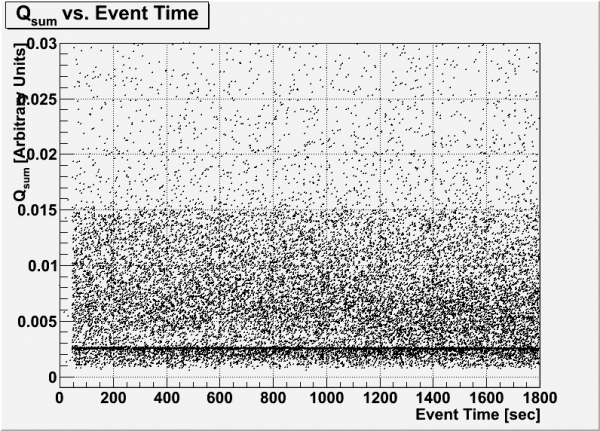 |
| Figure 10: +/-4 V Qsum vs Event Time: Side 2 |
|---|
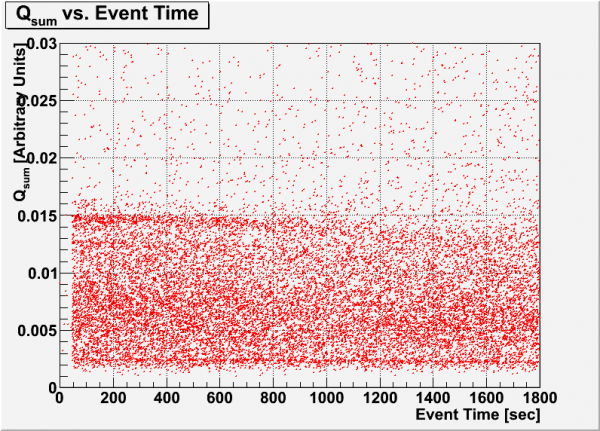 |
From Figure 10 above, it can be seen that the 356 keV (0.015 in the “arbitrary units”) peak dissolves between 600 and 800 seconds. Thus, it appears that charge neutralization is sufficient for the first 10 minutes.
| 1615 | Fill LN2 cold trap full. |
|---|---|
| Start flashing detectors. |