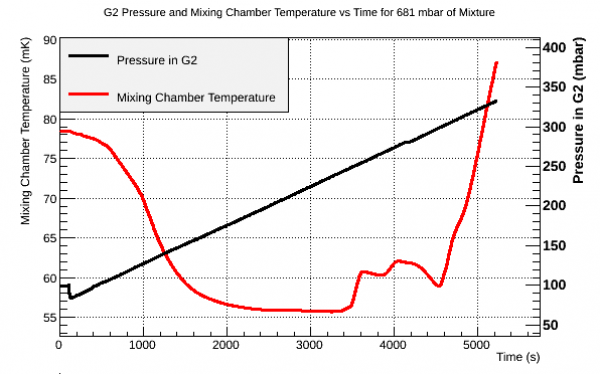
The single shot test performed today gave results shown in Figure 1 below. From the figure, which shows pressure in G2 (mbar) and mixing chamber temperature (mK) as a function of time, it can be seen that the single shot test was started at 102 seconds which resulted in a rapid (though slight) decrease in G2 due to V9 opening up the (not quite empty) dump. This rapid increase subsided at 126 seconds with G2=84 mbar. Once the test has been started, the mixing chamber temperature began to decrease, but the rate of decline increase at roughly 500 seconds (note: this takes longer than past single shot tests). This decrease is due to the He3 being pumped from the fridge to the dump. From 126 seconds (mixing chamber temperature of 78.4 mK) to 3249 seconds (mixing chamber temperature of 55.7 mK) the temperature in the mixing chamber decreases, allowing us to assume that the pressure increase during this time range is due to the accumulation of He3. During this total time of the single shot test (126 seconds to 3249 seconds) G2 increases from 84 mbar to 238 mbar, and thus 154 mbar if He3 was collected. This is roughly 23% He3 in the mixture.
| Figure 1: Single Shot Test Results |
 |