Table of Contents
2013/10/09
| 0120 | Still pressure has increased significantly, which is a little perplexing. Second spurt witnessed, so whatever has gone wrong doesn't seem to have affected the single-shot test. Cease single-shot test, turn off still heater and start recovering mixture by pumping from both sides of the fridge. |
|---|---|
| 0130 | Attempted to shut off 1 K pot and noticed that pumps had turned off. Unsure as to reasons why, but this is what appears to have caused the still pressure to leap up. Fortunately, it doesn't appear to have affected the single-shot test. Restart pumps and turn off 1 K pot. |
| 0140 | Fill N2 cold trap full. |
| 1030 | Fill N2 coldtrap. |
| 1100 | Begin LHe transfer (8.1%). |
| 1200 | End LHe transfer (95.4%). |
| 1530 | Recovered 570 mbar of mixture. Turn on mixing chamber heater (power 5 mW) to aid mixture recovery. |
| 1800 | Unpacked G101b and put in purge cabinet. Packed G102a for shipping. Electrical checks of both detectors below. |
| 1930 | Mixing chamber temperature 14.1 K; recovered 678 mbar of mixture. Turn off mixing chamber heater. |
Electrical Check of G101b
| Dib 1 | Dib 2 |
|---|---|
| All phonon channels open LED 1: 0.780MΩ, 1.064V, <0.4nS LED 2: Open Qo-Qi: 472Ω Qi-Qo: 185Ω | All phonon channels open LED 1: 0.796MΩ, 1.065V, <0.4nS LED 2: 0.790MΩ, 1.069V, <0.2nS Qo-Qi: 178Ω Qi-Qo: 157Ω |
Electrical Check of G102a
| Dib 1 | Dib 2 |
|---|---|
| QET A to Return: open QET B to Return: 41.2Ω QET C to Return: open QET D to Return: open LED 1: 0.783MΩ, 1.061V, <0.5nS LED 2: 0.760MΩ, 1.060V, <0.5nS Qo-Qi: 562Ω Qi-Qo: 153Ω | QET A to Return: open QET B to Return: open QET C to Return: 261Ω QET D to Return: 1.16kΩ LED 1: 0.777MΩ, 1.062V, <0.3nS LED 2: 0.756MΩ, 1.060V, <0.1nS Qo-Qi: 651Ω Qi-Qo: 171Ω |
Single Shot Test : 500 mbar of Mixture
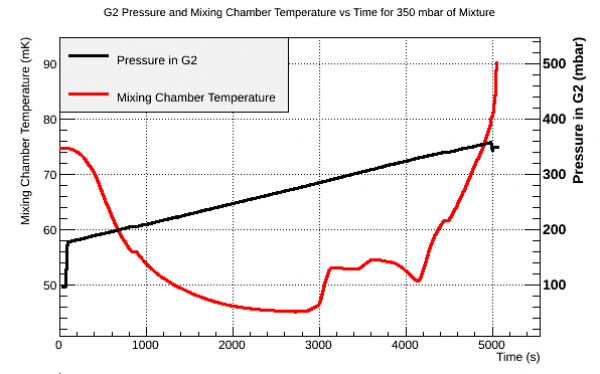
The single shot test performed today gave results shown in Figure 1 below. From the figure, which shows pressure in G2 (mbar) and mixing chamber temperature (mK) as a function of time, it can be seen that the single shot test was started at 64 seconds which resulted in a rapid increase in G2 due to V9 opening up the dump. This rapid increase subsided at 94 seconds with G2=177 mbar. Once the test has been started, the mixing chamber temperature began to decrease, but the rate of decline increase at roughly 140 seconds. This decrease is due to the He3 being pumped from the fridge to the dump. From 94 seconds (mixing chamber temperature of 74.5 mK) to 2764 seconds (mixing chamber temperature of 45.2 mK) the temperature in the mixing chamber decreases, allowing us to assume that the pressure increase during this time range is due to the accumulation of He3. During this total time of the single shot test (94 seconds to 2764 seconds) G2 increases from 177 mbar to 276 mbar, and thus 99 mbar if He3 was collected. This is roughly 20% He3 in the mixture.
| Figure 1: Single Shot Test Results |
|---|
 |