2013/10/07
| 0010 | Start single-shot test. |
|---|---|
| 0135 | Single-shot test complete. Stop 1 K pot and turn on mixing chamber heater (power 5 mW) - commence mixture recovery. |
| 0330 | Fill N2 cold trap full. |
| Turn off mixing chamber heater. | |
| 1125 | Begin LHe transfer (4.8%). |
| 1140 | Filled LN2 coldtrap full. |
| 1210 | End LHe transfer (73.1%). |
| 1730 | Start 1 K pot, temperature 1.88 K. Stop mixture recovery, dump pressure 681 mbar. Mixing chamber temperature 9.0 K. Commence manual mixture condensation procedure. |
| 1820 | Valve V12A fully open; manual condensation procedure complete, 500 mbar dump pressure of mixture in fridge. Mixing chamber temperature 5.3 K and falling. |
| 1935 | Mixing chamber temperature 2.8 K. Commence manual circulation procedure. |
| 2235 | Fully open valve V6; manual circulation procedure complete. Wait for mixing chamber to reach base temperature. |
| 2335 | Reduce 1 K pot temperature to 1.66 K. |
| 2355 | Fill N2 cold trap full. |
Single Shot Test : 450 mbar of Mixture
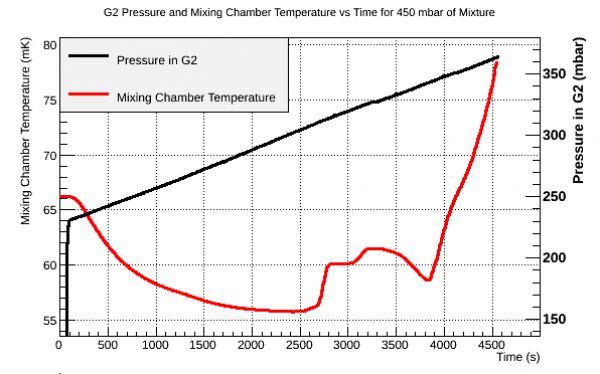
The single shot test performed today gave results shown in Figure 1 below, which shows pressure in G2 (mbar) and the temperature in mixing chamber (mK) as a function of time. It can be seen that the single shot test was started at 65 seconds which resulted in a rapid increase in G2 due to V9 opening up the dump. This rapid increase subsided at 95 seconds with G2=219 mbar. Once the test has been started (at 65 seconds), the mixing chamber temperature begins to decrease. The rate at which the temperature drops increases around 120 sec. This is due to the He3 being pumped from the fridge to the dump. From 95 seconds (mixing chamber temperature of 66.2 mK) to 2419 seconds (mixing chamber temperature of 55.7 mK) the temperature in the mixing chamber decreases. We can assume that the pressure increase while the temperature drops (from 65 seconds to 2419 seconds) is due to the accumulation of He3. During this time range G2 increases from 219 mbar to 300 mbar, and thus 81 mbar if He3 was collected. This is roughly 18% He3 in the mixture.
| Figures 1: Single Shot Test Results |
|---|
 |