2013/10/01
| 1120 | Filled LN2 coldtrap full. |
|---|---|
| 1420 | Begin single shot test with mixing chamber temperature at 57.0 mK. |
| 1555 | Single shot test completed. Stop 1 K pot, open valve V5 on IGH and turn on mixing chamber heater to 5 mW to hasten recovery of mixture. |
| 2030 | Recovered 682 mbar of mixture. Cease recovery and close all valves on IGH. Close nitrogen cold trap 1 speedivalve and extract nitrogen cold trap 1 from its bath. Switch exhaust of 1 K pot pump from helium recovery to atmosphere. Open line from nitrogen cold trap 1 to 1 K pot pump and evacuate as it warms to room temperature. |
| 2115 | Close condenser line speedivalve and gate valve to isolate fridge just in case. Turn off mixing chamber heater as temperature is >14 K. Commence cleaning nitrogen cold trap 1. |
| 2130 | Finish first cycle of cold trap cleaning. Wait for trap to cool down. |
| 2210 | Finish second cycle of cold trap cleaning. Wait for trap to cool down. |
| 2340 | Cease evacuating trap and place back in nitrogen bath. Commence cryocleaning mixture through nitrogen cold trap 1. |
| 2350 | Fill N2 cold trap full. |
Single Shot Test : 350 mbar of Mixture
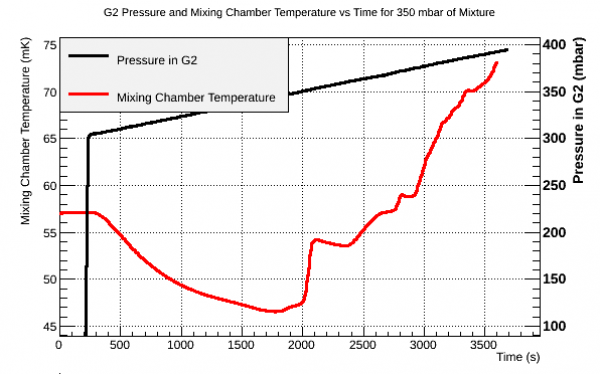
The single shot test performed today gave results shown in Figure 1 below. From the figure, which shows pressure in G2 (mbar) and mixing chamber temperature (mK) as a function of time, it can be seen that the single shot test was started at 210 seconds which resulted in a rapid increase in G2 due to V9 opening up the dump. This rapid increase subsided at 246 seconds with G2=304 mbar. Once the test has been started, the mixing chamber temperature remains relatively constant for about 20 seconds before beginning to decrease. This decrease is due to the He3 being pumped from the fridge to the dump. From 246 seconds (mixing chamber temperature of 57.1 mK) to 1776 seconds (mixing chamber temperature of 46.5 mK) the temperature in the mixing chamber decreases, allowing us to assume that the pressure increase during this time range is due to the accumulation of He3. During this time range G2 increases from 304 mbar to 349 mbar, and thus 45 mbar if He3 was collected. This is roughly 13% He3 in the mixture.
| Figure 1: Single Shot Test Results |
|---|
 |