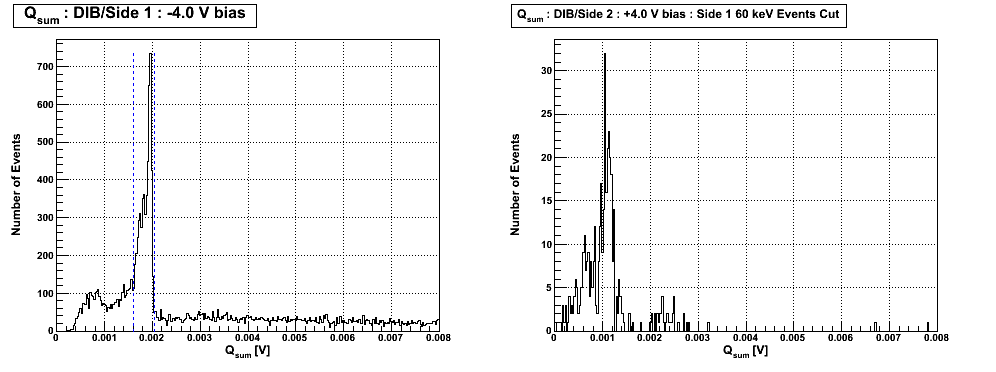
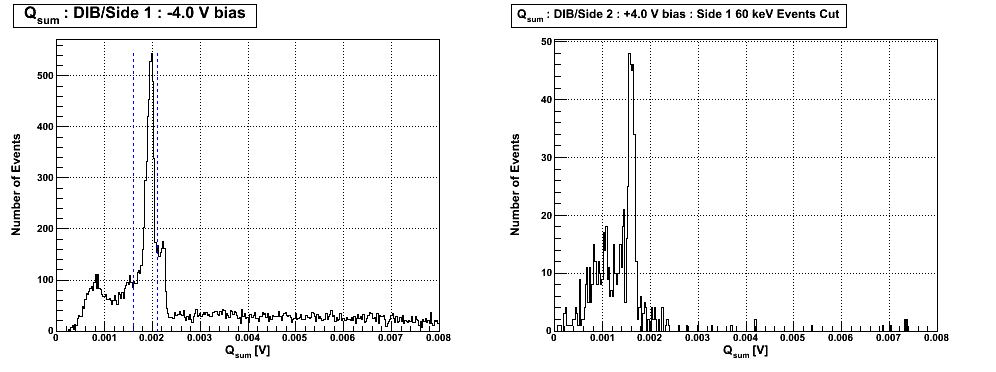
Paul raised the point about neutrlisation during Monday's DTC meeting, and it seems as though the crystal was not neutralised sufficiently well at the beginning of this run. Fig. 1 shows Qsum spectra from the first four data series at -/+4 V bias, taken after the first 4-hour flash and +/-4 V data series. The peak on Side 1 appears to be pretty clear, and a lot of electrons are lost on their way to Side 2 resulting in a peak at roughly 1.1 mV. However, Qsum spectra data series at the same bias a couple of days later after another 4-hour flash indicate that the Side 2 peak has shifted to a mean position of 1.6 mV, as shown in Fig. 2. The only explanation for this is poor neutralisation, thus falsely implying poor charge collection efficiency for electrons at this bias.
| Figure 1: Qsum Spectra for Sides 1 & 2; -/+4 V bias; taken on 25th August 2013. |
 |
| Figure 2: Qsum Spectra for Sides 1 & 2; -/+4 V bias; taken on 27th August 2013. |
 |
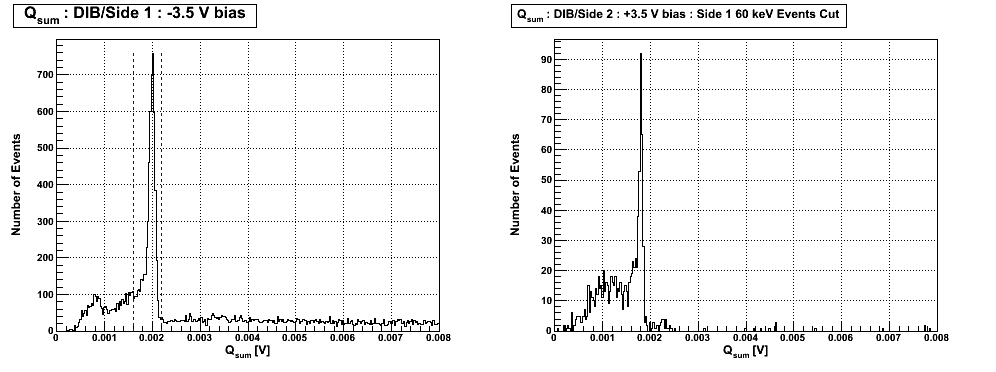
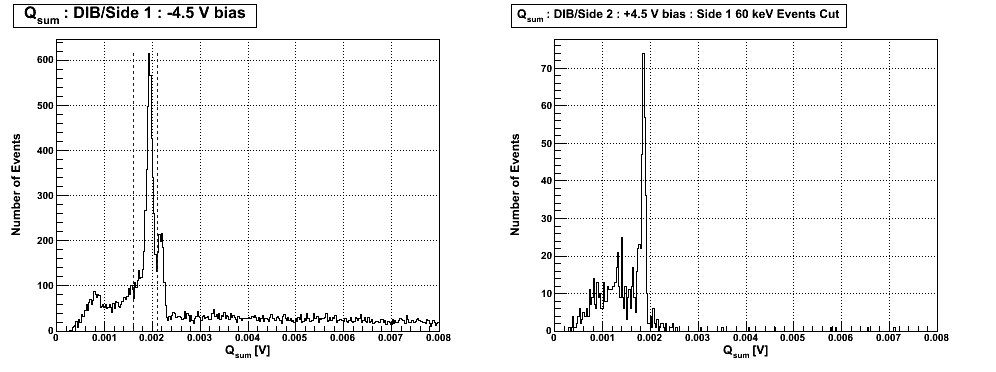
The situation gets worse, as the following day data series were acquired at -/+3.5 V (Fig. 3) & -/+4.5 V (Fig. 4) biases after another 4-hour flash. The 60 keV peak on Side 2 in Fig. 3 has a mean position just shy of 1.8 mV, which would imply that charge collection efficiency is greater at a lower bias. Of course, this doesn't make sense, and would imply that the detector was still not fully neutralised.
| Figure 3: Qsum Spectra for Sides 1 & 2; -/+3.5 V bias; taken on 28th August 2013. |
 |
| Figure 4: Qsum Spectra for Sides 1 & 2; -/+4.5 V bias; taken on 28th August 2013. |
 |
Tests should be performed on the LEDs to find an ideal flashing scheme. Additionally, data at a few select biases should be taken after a long flash, and compared with the data retaken at these biases after another long flash to determine if the new scheme has worked.