2012/08/28
| 0125 | Mixing chamber temperature 103.7 mK, still thermometer 4.43 kΩ, cold plate thermometer 14.3 kΩ. Pressures in P1, G1 & G2 are 0.14 mbar, 69 mbar & 73 mbar respectively. Temperature of 1 K pot is 1.71 K. |
|---|---|
| Mixing chamber temperature is lower than last measurement, which is unexpected. Still and cold plate are a little colder, but nothing to write home about… yet… we can keep going. Bleed mixture out of dump. Pressure in G2 peaks at 110 mbar. Mixing chamber temperature reaches 110 mK. | |
| 0240 | Fill N2 cold trap full. |
| 0315 | Mixing chamber temperature 105.3 mK, still thermometer 4.44 kΩ, cold plate thermometer 14.5 kΩ. Pressures in P1, G1 & G2 are 0.14 mbar, 73 mbar & 76 mbar respectively. Temperature of 1 K pot is 1.71 K. |
| Bleed mixture out of dump. Pressure in G2 peaks at 108 mbar. Mixing chambe reaches 111 mK. | |
| 0945 | Fed Cricket 3 pellets. |
| 1052 | There seems to have been a power failure sometime in the early morning. Reset the power for the pumps. |
| Started 1K pot. | |
| Turned on He3 pump. | |
| Opened V13A, V12A, V1, and V6 to 12%. Re-starting circulation. | |
| Re-started Kelvinox VIs. Created a new temperature file listed under 20120828 folder. IGH file is still being plotted in 20120729. | |
| 1127 | V6 is now opened all the way. Temperature has been steadily decreasing |
| 1155 | Start LHe transfer. LHe level is -0.6% |
| 1225 | End LHe transfer (89.8%). |
| 1244 | Base temperature seems to have stabilized around 104 mK. still thermometer 4.44 kΩ, cold plate thermometer 14.4 kΩ. Pressures in P1, G1 & G2 are 0.14 mbar, 77 mbar & 81 mbar respectively. Temperature of 1 K pot is 1.70 K. |
| 1253 | Pull mixture out of dump by keeping V14 open until G2 rose to 90 mbar. After closing V14, G2 rose to 109 mbar. |
| 1304 | Temperature rose to 111 mK. |
| 1435 | Mixing chamber temperature 107.0 mK, still thermometer 4.44 kΩ, cold plate thermometer 14.6 kΩ. Pressures in P1, G1 & G2 are 0.14 mbar, 80 mbar and 85 mbar respecively. Temperature of 1 K pot is 1.72 K. |
| Bleed mixture out of dump. Pressure in G2 rises to 101 mbar. Mixing chamber temperature rises to 110 mK. | |
| 1607 | Mixing chamber temperature 108.7 mK, still thermometer 4.43 kΩ, cold plate thermometer 14.7 kΩ. Pressures in P1, G1 & G2 are 0.14 mbar, 81 mbar and 87 mbar respectively. Temperature of 1 K pot is 1.71 K. |
| Bleed mixture out of dump. Leaving V14 open until it reaches 0.14 mbar | |
| 1641 | Changed our minds. Closed V14 when it went below 1 mbar. Temperature seems to have spiked around 118 mbar. |
| 1845 | Mixing chamber temperature 117.0 mK, still thermometer 4.44 kΩ, cold plate thermometer 16.2 kΩ. Pressures in P1, G1 & G2 are 0.15 mbar, 93 mbar & 99 mbar respectively. Temperature of 1 K pot is 1.70 K. |
| Fill N2 cold trap full. | |
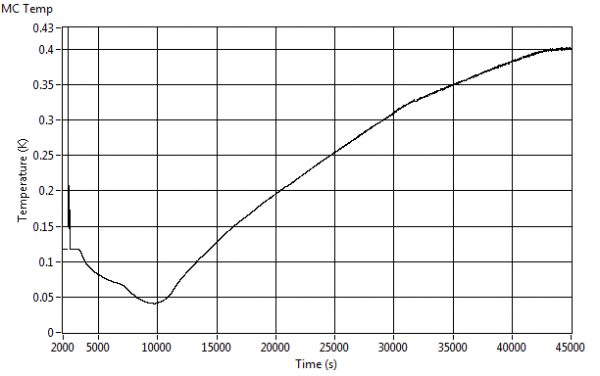
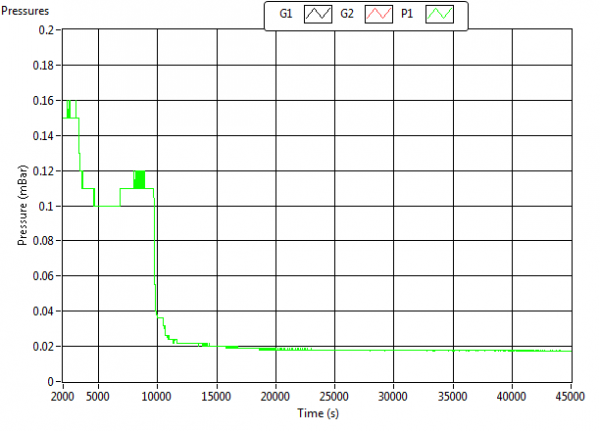
| 1850 | Start single-shot test. |
 |
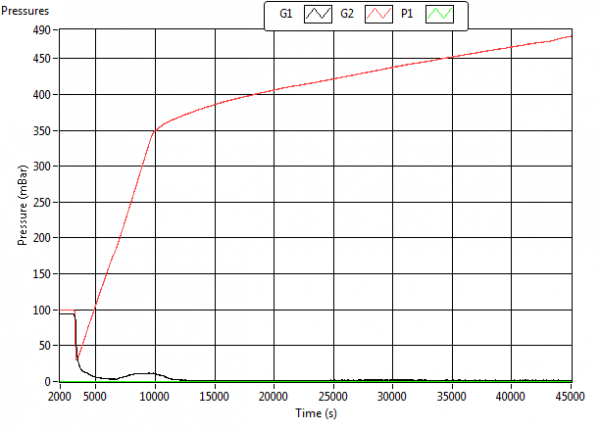 |
| First ascent: 3 mbar/min |
 |
Thoughts on Loss of Base Temperature
- Phase boundary is not in mixing chamber, ie. there is not enough He-3.
- Can be tested with single-shot method.
- If it takes a while before the temperature of the mixing chamber decreases, there is too much He-3. Mixing is occuring in the line to the still. Mixture is pumped out, but mixing chamber only starts cooling once enough has been extracted for mixing to occur in the mixing chamber.
- If temperature of mixing chamber does not decrease at all during this process, there is not enough He-3. Mixing is occuring in the line to the condenser. Mixture is pumped out, but no mixing occurs in mixing chamber during this process.
- Ruled out: single-shot tests not only show that there is 180-190 mbar (dump pressure) of He-3, but the mixing chamber starts cooling immediately.
- Too much mixture.
- Still would be overflowing. Recondensing mixture would provide large heat load through still heat exchanger.
- Pressure in still should be high and it should not cool below 1 K even with the still heater off.
- Possible: no calibration available for still thermometer, but is warmer than it should be. Additionally, pressure in still is higher than expected. In this case, adding more mixture would result in a higher heat load, and hence a higher base temperature. For the most part, this is what is seen.
- Too little mixture.
- Still would be dry. Liquid level would be heat exchanger.
- Due to reduced liquid surface area, He-3 circulation rate would be low. Still pressure should be low and still temperature should be high.
- Can be tested by heating the still. If circulation rate does not change, but still heats up, then this would appear to be the problem.
- Unlikely: He-3 circulation rate appears to be low when looking at G1 & G2, but still pressure is higher than it should be. Additionally, heating the still does indeed warm it up, but also causes higher pressures in G1 & G2 indicating that circulation rate does increase.
- Thermal contact between stages.
- Results in poor base temperature and cooling power.
- Possible: both of the above are true. It is possible that a sudden increase from 60 mK to 80 mK was a result of something moving around.
- Blockage in circulation line.
- Circulation rate should drop, and an increase in pressure should be witnessed in the return line.
- Possible: difficult to tell without helium gas flow meter. Pressures in G1 & G2 did increase from 40 mbar to at least 80 mbar prior to the sudden loss of base temperature. Unknown what G1 & G2 pressures were when base temperature failed as no record was taken at the time.
- Leak from mixing chamber lines or main bath to IVC.
- Results in poor base temperature and cooling power.
- Possible: conducting a leak check at 4.2 K yields a very high helium leak rate of around 10E-5 mbar l/s. However, isolating the IVC for 10 hours results in no change in temperature during this time. One would expect mixing chamber temperature to decrease to 4.2 K as helium from main bath leaks into IVC and acts as an exchange gas. However, mixing chamber temperature remains constant. Perhaps this simply cancels out slow warming of the mixing chamber through conduction with the outside world. The leak could also be between mixing chamber lines and the IVC.
Easiest to check is the possibility of there being too much mixture. Pumping out the mixture, warming up to 4.2 K, and then recondensing and recirculating a smaller amount (300 mbar dump pressure for example) should tell us something. Too little mixture is very unlikely as not all the conditions are satisfied. Checking for thermal contact between stages is not possible at the moment. If we have data on throughput tests at 4.2 K, perhaps we can check for a blockage. Checking for a leak can be done at liquid nitrogen temperatures. Additionally, one can leave the IVC isolated overnight and observe the pressure. Finally, mixture can be dumped inside the fridge when the mixing chamber is at 4.2 K and left overnight.
We can start with the possibility of there being too much mixture, followed by leak checks at 4.2 K and a throughput test. If none of these provide a solution, we can cool down to whatever base temperature we can reach, take the remaining charge-only data, warm up to liquid nitrogen temperatures, and try again. Finally, we can warm up to room temperature, uninstall the tower, and conduct an empty run.