I'm currently working on the development of a neutron-blocking polyethylene shield. The polyethylene being used is high-density and natural (not borated), and thus I shall continuously refer to it as HDPE. HDPE is a good way to moderate neutrons because it's molecular formula is of the form CH2-CH2, which, we see, holds a lot of hydrogen. Thus, when a neutron hits the shield it will transfer part of its energy to the protons (the hydrogen atoms in the HDPE). If we make the shield thick enough, the neutron will hit enough protons that it will transfer all its energy and not make it through the shield to the detector.
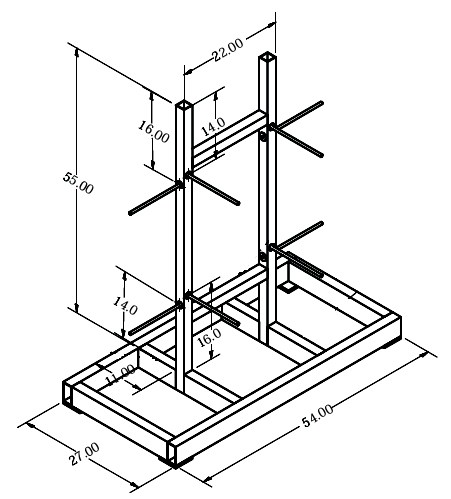
This is (half of) the design for the skeleton structure of the neutron polyethylene shield. Two of these structures are going to be made. On the side where we see a full dimension of 54 inches, we are going to slide on 8 slabs of HDPE of 22“x55”. Each slab is an inch thick, which allows us to achieve our goal of about 20 cm thickness for our shield. When the two structures are made and put together, we will slide on larger slabs of 42“x55” on the sides adjacent to the 22“x55” slabs. This ensures us a minimum of 8“ thickness around the sides of the dewer. The sides with the smaller slabs of 22×55 will be permanently connected to the shield. When we conduct tests with the shield in place, the two structures will be brought together around the dewer. Before placing on the larger slabs, we will have to slide underneath the dewer 8 more slabs of HDPE of 22”x22“ to protect the dewer from neutrons below.
Unfortunately, we can't place slabs above the dewer, so the shield has been designed with walls as high as possible to limit the available solid angle that neutrons can arrive through to the detector. Also, we are going to try and insert some HDPE within the cryostat closely above the detector to protect it from neutrons coming directly from above. The design for that has not yet been started.