HVeV R3
HVeV Run 3 consists of 44 days of 100V data beginning December 27th, 2020. Analyses as they are finished updated will be posted here as hyperlinks to SLAC Confluence pages.
Resolution Study with New Pi Filters: In Progress - Derek
Below is the link to the resolution study that was focused around the day the pi filters were changed. The goal was to determine if and what changed after swapping out the old pi filters.
R7 (HVeV R3) Resolution Over Time: Just needs some finishing Touches - Derek
The following link leads to a study on the resolutions for HVeV R3 over the entire 44 days of 100V data. The goal was to understand how the resolutions behaved over the long term scale of the run. This includes baseline resolution and the resolution for the First electron-hole pair peak (needs to be updated).
R7 (HVeV R3) Mean Baseline and Temperature studies: In Progress, not documented yet - Derek
What initially started as a study to form initial mean baseline cuts has turned into a study focused on mean baseline correction first and for most and then the development of effectient cuts. The correction is currently in progress and is documented here:
With the new updated calibration methods of either calibrating to zero or to a saturated pulse as stated below, we have found there are a few other issues plaguing the study. First, when using the zero calibrating point, there is a day where a squid jump occurs and one channel had to be re-locked. This requires the data to be analyzed as a before and after set instead of just a single set of data. On top of this, some basic quality cuts are required and I'm in the process of creating some loose baseline and slope cuts.
It turns out that the mean baseline correction methods we were using are insufficient. The amplitude is not a good RQ to use for measuring the actual saturated pulses and as such a new RQ is going to need to be developed.
Mean Baseline Calibration Update 1
This isn't quite finished. I need to switch which OF algorithm was used, form some very basic quality cuts, and calibrate the mean baseline to a known value (for example how the baseline looks during a fully saturated pulse, such as a muon event). After that, doing the process of the actual correction hasn't quite been done yet so I should be sure to implement that, though most of the difficult parts are finished.
Here is a quick look at the new RQ I made and how it changes the way amplitude is measured for the saturation pulses:
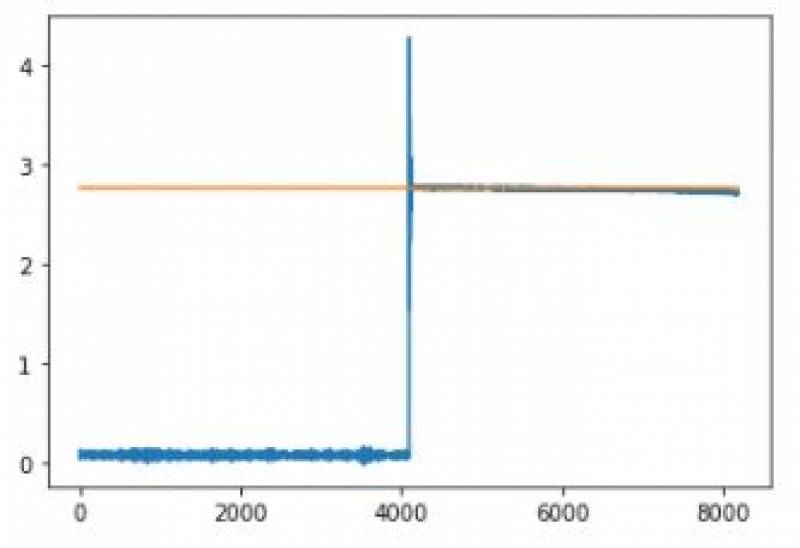
The RQ loads up a trace and looks at bins 100-200 after the trigger point and averages over those bins and returning that value. Here is an example of what the RQ produces on a single trace:
This is then repeated over every trace in a series and then the location of that saturated events from baseline+amplitude and baseline+newRQ are compared. You can see those below:
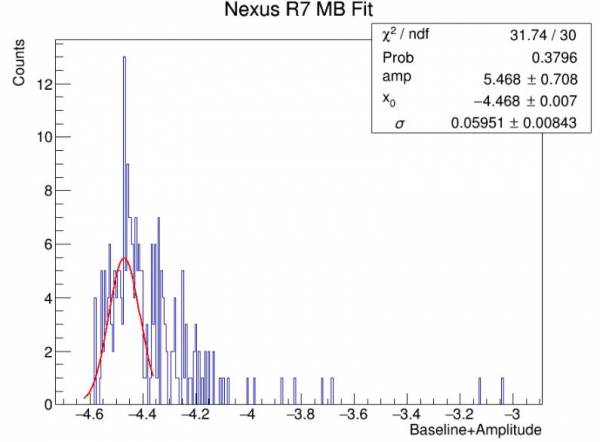 | 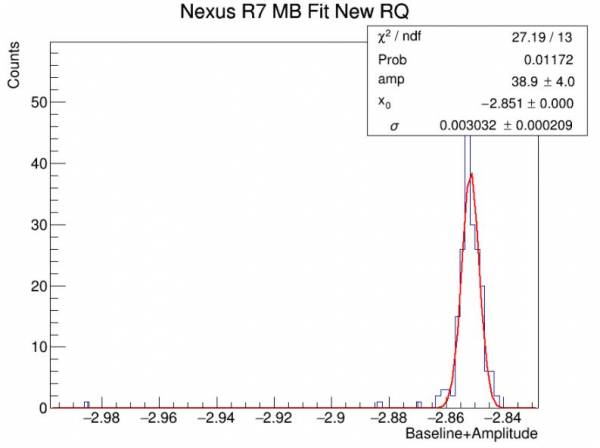 |
As you can see the resolution of the RQ has improved by over an order of magnitude, but it is still the dominate factor in the uncertainty of baseline+RQ.
210807 - The overall baseline correction is almost complete. A few small adjustments need to be made (selecting the data and applying loose cuts) before I am happy enough with it to present at the meeting.